

How Strategy Consulting Can Transform Your Business
Businesses rarely struggle because they lack ideas. More often, they struggle to decide which opportunities deserve attention, where resources should go, and how to turn ambitious goals into practical actions. Strategy consulting helps leadership teams answer these questions with structured analysis and clearer priorities.
For people researching pedrovazpaulo strategy consulting, understanding what strategy consultants actually do is an important starting point. Effective consulting goes beyond offering general business advice. It involves examining the company, its market, competitors, capabilities, risks, and long-term objectives before recommending a realistic direction.
This guide explains strategy consulting from both a business and career perspective. You will learn what consultants do, why organizations hire them, how a typical engagement works, how results should be measured, and which skills can help someone build a career in this field.
Read also: PedroVazPaulo business consultant operations
What is Strategy Consulting?
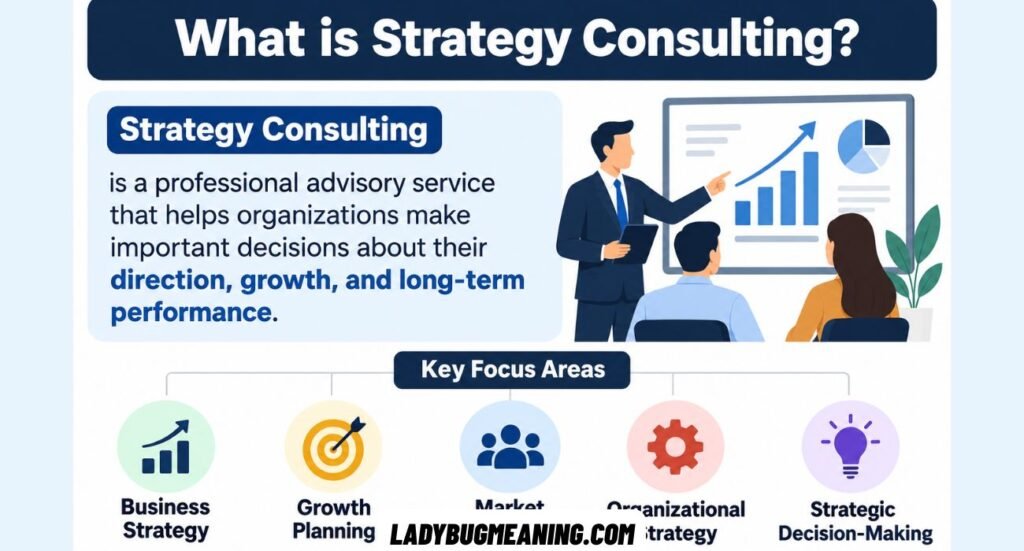
Strategy consulting is a professional advisory service that helps organizations make important decisions about their direction, competitive position, growth, and long-term performance. Consultants analyze complex business problems, develop possible solutions, and help decision-makers understand the trade-offs involved.
The work can cover corporate strategy, market entry, growth planning, competitive positioning, organizational priorities, portfolio decisions, digital transformation, pricing, and other high-level challenges.
Unlike advice focused mainly on routine daily activities, strategy consulting usually deals with questions that can influence an organization’s future. A company might need to decide whether to enter a new market, launch a new service, change its business model, acquire another company, or redirect investment toward its strongest opportunities.
Definition and Scope
At its core, strategy consulting connects a company’s current position with where it wants to go.
A consultant first needs to understand the problem. This can involve reviewing financial and operational information, interviewing stakeholders, studying customers and competitors, examining industry conditions, and identifying internal strengths or weaknesses.
The scope depends on the engagement. Common areas include business strategy, competitive analysis, market entry strategy, growth strategy, organizational strategy, strategic planning, transformation, and performance improvement.
A useful strategy should ultimately answer three questions: Where are we now? Where do we want to go? What choices and actions will realistically get us there?
Importance in Modern Business
Modern companies operate in environments shaped by changing customer expectations, new technologies, economic uncertainty, regulation, and intense competition. Decisions that once worked for years may need to be reconsidered much sooner.
Strategy consulting can help leadership teams evaluate these changes systematically instead of responding to every trend independently.
External consultants can also challenge internal assumptions. Managers naturally develop strong beliefs about their company and industry. An independent analysis may reveal overlooked competitors, underserved customer groups, inefficient investments, or risks that are difficult to recognize from inside the organization.
Consulting, however, does not remove uncertainty. A sound strategic recommendation should clearly distinguish evidence from assumptions and explain the risks attached to major decisions.
Roles and Responsibilities of a Strategy Consultant
A strategy consultant’s responsibilities vary according to the client and project. However, most engagements combine research, analysis, problem solving, communication, recommendation development, and some degree of implementation planning.
| Responsibility | Typical Purpose |
|---|---|
| Business analysis | Understand current performance and capabilities |
| Market research | Evaluate customers, competitors, and market conditions |
| Strategic planning | Identify priorities and possible courses of action |
| Financial analysis | Examine the economic impact of strategic choices |
| Scenario analysis | Compare possible future outcomes |
| Recommendations | Translate evidence into practical decisions |
| Implementation guidance | Help convert strategy into actions and milestones |
| Performance measurement | Determine whether the strategy is producing results |
Business Analysis
Business analysis establishes the company’s starting position.
A consultant may examine revenue streams, customer segments, costs, processes, organizational capabilities, products, sales performance, profitability, and other relevant information. The exact analysis depends on the strategic question being investigated.
Frameworks such as SWOT analysis, value-chain analysis, portfolio analysis, and competitive assessment can help organize information. They should not replace judgment. A framework is valuable only when it helps uncover information that affects an actual decision.
For example, a company experiencing slower growth may initially believe that marketing is the problem. Analysis might instead reveal poor customer retention, weak product differentiation, an unattractive target segment, or an inefficient sales model. Identifying the correct problem is often more important than immediately proposing a solution.
Market Research
Companies do not operate independently of their markets. Consultants therefore study the external environment as well as internal performance.
Research can include customer needs, competitor positioning, industry trends, market size, barriers to entry, pricing, substitutes, distribution channels, regulation, and potential market changes.
Both quantitative and qualitative evidence can be useful. Industry data can show market direction, while customer interviews or stakeholder discussions may help explain why a pattern exists.
The goal is not simply to collect information. Consultants need to determine which findings have strategic consequences.
Implementation Guidance
A strategy has limited value if the organization cannot execute it.
Implementation guidance converts recommendations into priorities, responsibilities, timelines, milestones, and measurable outcomes. Depending on the engagement, consultants may help leadership teams establish workstreams, define performance indicators, identify resource requirements, or create a roadmap.
Strong implementation planning also identifies dependencies. A growth strategy, for example, may require new technology, additional employees, different pricing, updated sales processes, or investment before meaningful results can appear.
Why Businesses Require Strategy Consulting
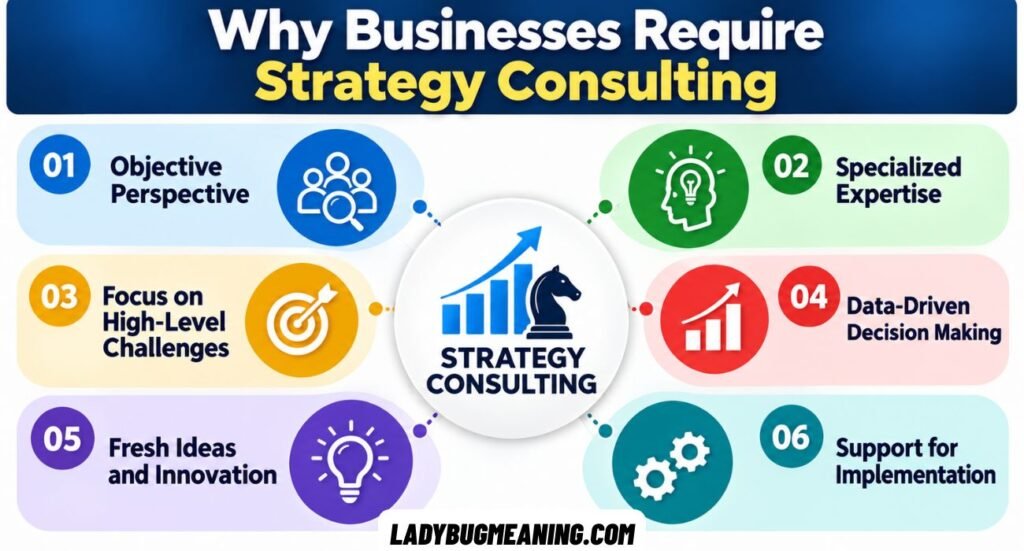
Organizations typically seek strategy consulting when the consequences of a decision are significant or when internal teams need additional expertise, capacity, or independent analysis.
Not every business problem requires an external consultant. Routine decisions that an experienced internal team can handle efficiently may not justify the additional cost. Consulting becomes more valuable when the issue is complex, unfamiliar, cross-functional, or strategically important.
Objective Perspective
Internal knowledge is valuable, but familiarity can sometimes make assumptions harder to question.
An external consultant can examine the situation without the same organizational history, departmental interests, or attachment to previous decisions. This perspective can help management test whether long-held beliefs still match current evidence.
Objectivity does not mean consultants are automatically correct. Their recommendations should still be evaluated against reliable data, operational realities, financial constraints, and the experience of people inside the company.
Specialized Expertise
Some strategic decisions require capabilities that an organization does not regularly maintain internally.
A company entering a new market, redesigning its operating model, evaluating an acquisition, or responding to major industry disruption may benefit from specialized research and analytical expertise.
Experienced strategy consultants may also bring structured problem-solving methods developed across different business situations. The value comes from applying relevant expertise to the client’s specific circumstances rather than imposing a standard solution.
Focus on High-Level Challenges
Senior executives often divide their attention across employees, customers, operations, investors, budgets, and immediate business problems. A major strategic question may require deeper analysis than the leadership team can reasonably perform alongside normal responsibilities.
Consultants can dedicate focused resources to the issue.
They can break a broad question into smaller problems, gather evidence, evaluate alternatives, and present the consequences of different choices. This creates a more structured foundation for executive decision-making.
Read more: Pedrovazpaulo marketing consulting
How a Strategy Consulting Engagement Typically Works
Understanding the consulting process helps businesses evaluate what they are actually paying for. Although individual engagements vary, most successful projects follow a logical progression.
1. Define the Strategic Problem
The engagement should begin with a precise question.
“Improve our business” is too broad. “Determine whether entering a specific market can generate acceptable returns within our risk limits” gives the team something that can actually be investigated.
Clear problem definition also prevents unnecessary research.
2. Establish the Current Position
Consultants gather relevant internal and external information. This may include company performance, customer behavior, competitor activity, financial information, organizational capabilities, and market conditions.
The quality of the strategy depends heavily on the quality of this evidence.
3. Identify Strategic Options
Most meaningful business problems have more than one possible solution.
Consultants can develop alternative scenarios and compare their advantages, costs, risks, resource requirements, and potential outcomes. Decision-makers can then understand not only what is recommended but why it may be preferable to the alternatives.
4. Choose Priorities
Strategy requires choices.
Companies rarely have unlimited capital, employees, technology, or management attention. A practical strategy therefore identifies what deserves investment and, equally important, what the organization will not prioritize.
5. Build an Implementation Roadmap
The selected direction is translated into actions.
The roadmap may specify responsibilities, deadlines, investments, milestones, dependencies, and key performance indicators. Major assumptions should also be documented so leadership can revisit the strategy if conditions change.
6. Review Performance
Strategy should not become a document that is created once and forgotten.
Management needs to compare actual performance against agreed indicators and review whether important assumptions remain valid. Significant changes in customer demand, competition, technology, regulation, or financial conditions may justify an adjustment.
How Pedrovazpaulo Strategy Consulting Should Be Evaluated
When researching pedrovazpaulo strategy consulting, prospective clients should evaluate the service using the same standards they would apply to any strategy advisory provider.
Start with the problem you need solved. Then determine whether the consultant demonstrates relevant expertise, a credible analytical approach, transparent deliverables, and an implementation method suited to your organization.
Before engaging any consulting provider, consider questions such as whether the scope is clearly defined, which data will support recommendations, who will perform the work, what deliverables will be produced, and how success will be measured.
Businesses should also independently verify material claims about experience, qualifications, client results, or industry expertise before relying on them. Case studies are most useful when their context, starting conditions, consultant contribution, and measurement methods are clear.
A credible consulting relationship should help leaders make better decisions rather than create dependence on outside advice.
Strategy Consulting vs. Management Consulting
The terms strategy consulting and management consulting are sometimes used interchangeably, but they are not identical.
| Area | Strategy Consulting | Management Consulting |
|---|---|---|
| Primary focus | High-level direction and major decisions | Broader organizational improvement |
| Typical questions | Where should the company compete and grow? | How can the organization perform better? |
| Time horizon | Often medium to long term | Short, medium, or long term |
| Common projects | Growth, market entry, corporate strategy | Operations, technology, organization, processes |
| Typical stakeholders | CEOs and senior leadership | Executives and functional managers |
In practice, the boundaries can overlap. A strategy recommendation may create operational, organizational, technology, or financial work that falls into broader management consulting.
The important issue for a client is not the label. It is whether the consultant has the right capabilities for the problem.
Benefits and Limitations of Strategy Consulting
Strategy consulting can provide significant value when the project addresses an important business decision and the organization is prepared to act on the findings.
Potential benefits include independent analysis, access to specialized expertise, structured decision-making, stronger prioritization, faster research, and clearer evaluation of strategic alternatives.
There are also limitations. Consulting can be expensive, recommendations depend on the accuracy of available information, and outside advisers may initially lack the contextual knowledge held by employees.
Implementation presents another challenge. Even a well-designed strategy can fail when responsibilities are unclear, resources are inadequate, employees are not aligned, or management does not consistently support the change.
For this reason, businesses should evaluate consulting value by the quality of decisions and resulting outcomes rather than by the number of presentations, frameworks, or reports produced.
How to Choose a Strategy Consultant
Selecting the right adviser requires more than reviewing an impressive presentation or website. The consultant needs to fit the organization’s actual problem.
Look for evidence of relevant expertise rather than broad claims of business knowledge. Someone experienced in corporate strategy may not automatically be the best choice for a highly specialized market-entry or transformation project.
Ask prospective consultants to explain how they would define the problem, what evidence they would need, how they test assumptions, how recommendations are developed, and what involvement they expect from the client’s team.
The engagement scope should also specify deliverables, responsibilities, timing, fees, confidentiality expectations, and how changes to the project will be handled.
Finally, consider knowledge transfer. A good engagement should leave the internal team with greater clarity and capability after the project ends.
Measuring the Success of Strategy Consulting
Consulting success should be connected to the original business objective.
If the project aims to improve profitability, relevant measures might include margins, cost structure, or returns on investment. A market-entry strategy may instead track customer acquisition, revenue, market penetration, or progress against launch milestones.
Some results take longer to appear. In those cases, leading indicators can show whether implementation is moving in the intended direction.
A practical measurement framework can include:
- Business outcomes: Revenue, profitability, market share, customer retention, or other objective-specific measures.
- Implementation progress: Completion of agreed strategic initiatives and milestones.
- Decision quality: Whether leaders have clearer evidence and criteria for major choices.
- Organizational adoption: Whether responsible teams understand and execute the strategy.
- Assumption validity: Whether the conditions supporting the original recommendation still exist.
Companies should ideally establish these measures before implementation. Otherwise, it becomes difficult to distinguish genuine strategic improvement from normal changes in business performance.
How to Get Into Strategy Consulting
Strategy consulting attracts people interested in business, analytical problem solving, research, and high-impact decision-making.
There is no single route into the profession. Employers differ in their requirements, and candidates can enter from business, economics, finance, engineering, technology, science, and other academic or professional backgrounds.
Educational Background
Many strategy consultants hold undergraduate degrees in areas such as business administration, economics, finance, engineering, mathematics, or related fields.
However, the subject of a degree is only one consideration. Employers may place significant weight on analytical ability, communication, structured thinking, academic performance, and relevant experience.
An MBA or another graduate degree can be useful for some career paths, especially for professionals seeking to move into consulting from another industry. It is not universally required.
Gaining Relevant Experience
Practical exposure can make a candidate much stronger.
Internships in consulting, corporate strategy, finance, research, analytics, operations, or business development can demonstrate that a candidate understands commercial problems.
People already working in another industry can build relevant experience by participating in strategic projects. Examples include evaluating new markets, developing business cases, improving pricing, conducting competitive analysis, or supporting organizational transformation.
Case competitions and structured case-interview practice can also help candidates develop the problem-solving approach commonly tested during consulting recruitment.
Important Skills Required
Analytical ability is essential, but strategy consulting requires a broader skill set.
Structured problem solving helps consultants break large, ambiguous questions into manageable components.
Quantitative skills help them interpret financial information, market data, forecasts, and business performance.
Research ability is necessary for separating reliable evidence from weak assumptions.
Communication skills allow consultants to explain complicated findings clearly to executives and other stakeholders.
Commercial judgment helps connect analysis to realistic business decisions.
Collaboration matters because consultants usually work with both consulting colleagues and client teams.
Strong consultants also need intellectual flexibility. Evidence sometimes contradicts the original hypothesis, and the consultant must be willing to change direction rather than defend an unsupported conclusion.
See also: Knee Twitching Spiritual Meaning
Common Strategy Consulting Mistakes Businesses Should Avoid
Hiring a consultant does not automatically create a successful strategy. The client organization also influences the outcome.
One common mistake is beginning with a vague objective. Without a specific problem, research expands while decision-making remains unclear.
Another is withholding important information. Consultants working from incomplete financial, operational, or customer data may reach conclusions that do not reflect the real business.
Companies can also become overly focused on attractive presentations. A sophisticated framework is not evidence that a recommendation will work. Management should examine the assumptions, supporting evidence, costs, risks, and practical requirements behind every major recommendation.
The final mistake is treating implementation as somebody else’s responsibility. Consultants can provide analysis and guidance, but company leaders remain responsible for decisions, resources, accountability, and sustained execution.
FAQs
What does a strategy consultant do?
A strategy consultant analyzes important business challenges, researches internal and external conditions, evaluates strategic options, and recommends practical courses of action. Projects commonly involve growth, competition, market entry, transformation, or corporate priorities.
What is pedrovazpaulo strategy consulting?
The term pedrovazpaulo strategy consulting refers to strategy-consulting services associated with the PedroVazPaulo name. Prospective clients should verify the provider’s current service scope, credentials, methodology, and evidence supporting performance claims before making a decision.
What problems can strategy consulting solve?
Strategy consulting can support decisions involving business growth, market entry, competitive positioning, corporate direction, portfolio choices, organizational transformation, and other complex strategic challenges.
Is strategy consulting only for large companies?
No. Smaller and mid-sized businesses can also use strategic advice, particularly when facing expansion, major investment decisions, competitive threats, or significant organizational change. The potential value should justify the consulting cost.
What is the difference between strategy consulting and business consulting?
Strategy consulting focuses mainly on high-level direction and major decisions. Business consulting is a broader term that may include strategy, operations, finance, marketing, technology, human resources, and other areas.
How long does a strategy consulting project take?
There is no universal project length. Timing depends on the complexity of the problem, availability of information, research requirements, number of stakeholders, and whether implementation support is included.
What qualifications are needed to become a strategy consultant?
Employers commonly value strong academic performance, analytical ability, communication, commercial understanding, and problem-solving skills. Business-related education can help, but candidates can enter the profession from many academic and professional backgrounds.
How should a company measure a strategy consultant’s value?
Measure value against the original objective using agreed indicators. Depending on the project, these could include profitability, growth, implementation milestones, customer outcomes, cost improvements, market performance, or better allocation of resources.
Conclusion
Strategy consulting helps organizations turn difficult business questions into structured decisions. Consultants can analyze company performance, study markets, challenge assumptions, compare alternatives, and create implementation roadmaps. The greatest value comes when rigorous analysis is combined with clear priorities, realistic execution, and measurable business objectives.
Businesses considering pedrovazpaulo strategy consulting should evaluate the service carefully rather than relying on a name or broad promise. Relevant expertise, transparent methodology, reliable evidence, clear deliverables, and measurable outcomes are stronger indicators of consulting value. When those elements align with committed leadership and effective execution, strategy consulting can become a useful tool for sustainable business improvement.


