
PedroVazPaulo Business Consultant: Operations Guide
Operations consulting helps businesses improve the way they work, manage resources, control costs, and deliver better results. It focuses on practical changes that make daily operations more efficient and support long-term growth. For business owners researching a PedroVazPaulo business consultant, understanding operations consulting can help them evaluate consulting services, identify business challenges, and decide which improvements deserve attention first.
Whether a company wants to reduce operating expenses, improve employee productivity, strengthen supply chain management, or prepare for expansion, an operations consultant can help turn business problems into a structured improvement plan. This guide explains the main areas of operations consulting, leading consulting firm categories, career opportunities, essential skills, and the factors businesses should consider before hiring a consultant.
Read also: Pedrovazpaulo marketing consulting
What Is Operations Consulting?
Operations consulting is a professional service that helps organizations improve their internal processes, resource allocation, performance, and operational decision-making. Consultants examine how a business currently works, identify inefficiencies, and recommend changes that can improve productivity, quality, customer satisfaction, and profitability.
An operations consultant may work with a small business, a growing startup, a large corporation, or a nonprofit organization. The exact work depends on the organization’s goals and challenges. For example, a retailer may need better inventory management, while a manufacturing company may want to reduce production delays. A service business may need clearer workflows, better scheduling, or improved customer support.
Unlike a strategy consultant who may focus primarily on long-term business direction, an operations consultant often concentrates on how the organization executes its plans. However, these areas overlap. A business strategy can only succeed when its people, processes, technology, and resources support it.
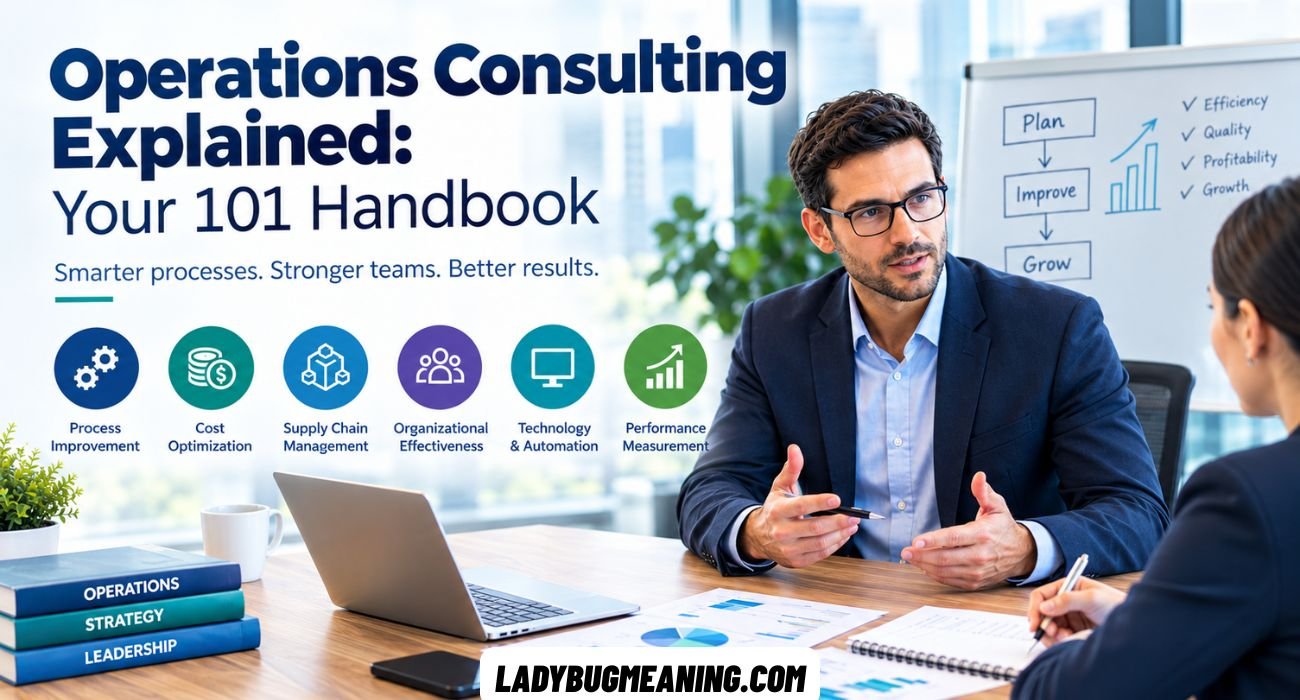
Key Focus Areas
Operations consulting covers several connected areas of business performance. The most relevant focus areas depend on the company’s size, industry, and operational maturity.
Process improvement involves examining existing workflows and removing unnecessary steps, delays, duplication, and bottlenecks. Consultants may map a process from beginning to end to understand where time, money, or effort gets wasted.
Cost optimization focuses on controlling expenses without damaging quality or customer experience. This might involve reducing avoidable spending, improving purchasing decisions, optimizing staffing schedules, or using existing equipment more effectively.
Supply chain and inventory management helps businesses coordinate suppliers, purchasing, storage, production, and delivery. Better planning can reduce stock shortages, excess inventory, and fulfillment delays.
Organizational effectiveness examines how teams, responsibilities, reporting structures, and management practices affect performance. Consultants may recommend clearer ownership of tasks, better communication, or more effective decision-making processes.
Technology and automation focuses on identifying repetitive tasks that software, integrated systems, or automation can handle more efficiently. The objective is not simply to introduce new technology but to solve a defined business problem.
Performance measurement involves selecting meaningful key performance indicators (KPIs) and using them to monitor progress. Depending on the organization, these may include order fulfillment time, operating cost per unit, defect rates, employee utilization, or customer satisfaction.
Typical Projects
An operations consulting engagement usually begins with a specific business challenge. The consultant gathers information, examines the current process, develops recommendations, and supports implementation when included in the agreed scope.
Common projects include redesigning customer service workflows, improving warehouse operations, standardizing procedures across multiple locations, reducing production waste, reviewing supplier performance, and implementing performance dashboards.
Consider a hypothetical distribution company that frequently delivers orders late. An operations consultant might review order data, warehouse picking procedures, staffing schedules, and transportation planning. The investigation could reveal that orders wait too long for approval or that inventory records are inaccurate. The consultant would then recommend targeted changes, establish performance measures, and help managers monitor whether delivery reliability improves.
Other projects focus on growth rather than an immediate problem. A company opening several new branches may need standardized operating procedures, clear management responsibilities, and a consistent reporting system. Operations consulting can help establish these foundations before expansion creates unnecessary complexity.
Value Proposition
The value of operations consulting comes from helping organizations understand their problems and make better-informed improvements. A consultant brings an outside perspective, a structured problem-solving approach, and analytical methods that may be difficult for a busy internal team to apply consistently.
The potential benefits include lower operating costs, faster workflows, more predictable service quality, improved resource utilization, stronger accountability, and better visibility into business performance. These benefits are not automatic. They depend on the accuracy of the diagnosis, the suitability of the recommendations, and the organization’s willingness to implement changes.
A useful consulting engagement should establish a baseline before making changes. For example, if a business wants to improve order processing, it should measure current processing time, error rates, and cost per order. After implementation, managers can compare the results with the baseline to determine whether the changes delivered value.
For a business exploring a PedroVazPaulo business consultant, the same principle applies: evaluate consulting proposals by looking for a clear understanding of the problem, a practical action plan, measurable objectives, and transparent reporting. Do not assume that a particular consultant has delivered specific results unless reliable evidence supports the claim.
How Does Operations Consulting Work?
Although every engagement is different, a structured consulting process helps businesses move from identifying a problem to measuring the results of a solution.
Step 1: Assess the Current Situation
The consultant gathers information about existing processes, business objectives, employee responsibilities, technology, and performance. This may involve interviews, process observations, financial reviews, and analysis of operational data.
The goal is to understand the actual causes of a problem rather than rely on assumptions. For instance, frequent customer complaints may result from poor communication between departments rather than insufficient staffing.
Step 2: Identify Problems and Opportunities
After reviewing the evidence, the consultant identifies bottlenecks, unnecessary costs, inconsistent procedures, and opportunities for improvement. The findings should distinguish urgent problems from changes that can wait.
Step 3: Develop an Improvement Plan
The consultant recommends specific actions, assigns priorities, estimates required resources, and establishes performance targets. A good plan considers cost, implementation time, employee readiness, and potential risks.
Step 4: Implement the Recommendations
Depending on the agreement, the consultant may help redesign workflows, introduce new systems, train employees, document standard operating procedures, or coordinate implementation with managers.
Step 5: Measure Results and Refine the Process
The business compares post-implementation performance with its original baseline. If the changes fail to produce the expected improvement, the team investigates why and adjusts the approach.
A consulting project should not end simply because a report has been delivered. When implementation support is part of the engagement, follow-up helps ensure that improvements become part of everyday work.
Top Operations Consulting Firms
Businesses can choose from large management consulting firms, specialist operations consultancies, and smaller independent advisers. The best option depends on the complexity of the problem, the company’s budget, its industry, and the level of implementation support it needs.
Big 3 Consulting Firms
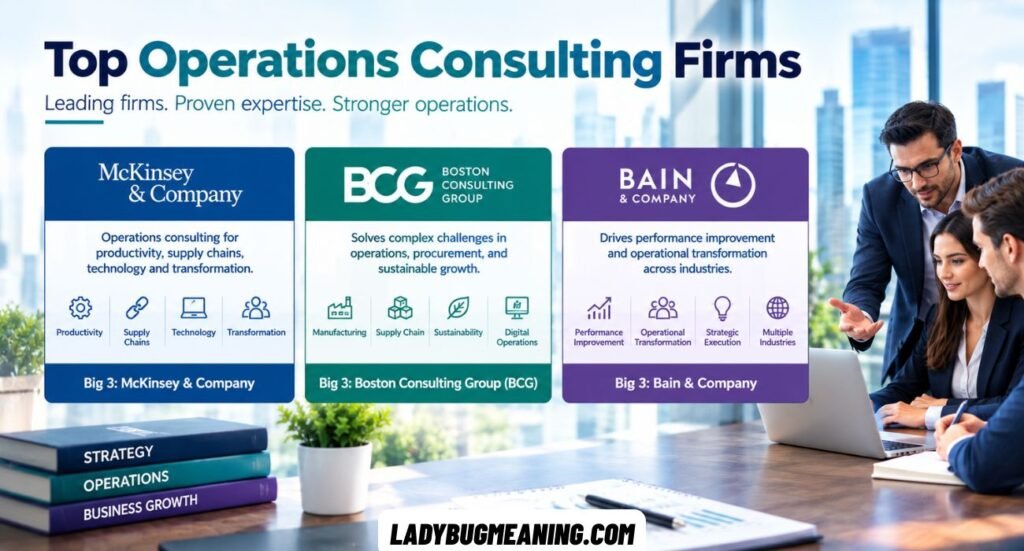
The term MBB refers to three prominent management consulting firms: McKinsey & Company, Boston Consulting Group (BCG), and Bain & Company. All work across strategic and operational challenges, although their offerings and project teams vary.

McKinsey & Company
McKinsey provides operations consulting covering productivity, manufacturing, supply chains, service operations, technology, and organizational performance. Its operations practice connects operational improvements with broader business transformation.
McKinsey & Company

Boston Consulting Group (BCG)
BCG works on procurement, manufacturing, supply chain management, capital projects, digital operations, and sustainable operations. Its work can be relevant to organizations seeking large-scale operational changes.
BCG

Bain & Company
Bain offers management consulting that includes performance improvement and operational transformation. Businesses evaluating Bain should examine the experience of the specific team and its proposed approach to implementation.
Large consulting firms can be suitable for complex, cross-functional programs that require substantial analytical resources and senior-level coordination. However, their services may be more extensive than a small business needs. Fees, staffing arrangements, and implementation responsibilities should be reviewed before signing an agreement.
Boutique Firms
Boutique consulting firms typically specialize in selected industries, business functions, or types of operational challenges. Some focus on supply chains, while others concentrate on process improvement, procurement, organizational design, or turnaround management.
Their smaller structure can provide more direct access to experienced consultants and a more focused engagement. Some also offer flexible project scopes that fit the needs of smaller organizations.
However, boutique firms differ widely in expertise and capacity. A business should ask who will perform the work, how the consultant will measure success, and whether the firm has relevant experience with similar operational problems.
Industry Specialists
Industry-specific consultants understand the processes, regulations, technical requirements, and performance pressures associated with a particular sector. This knowledge can be valuable when a general improvement framework is not enough.
For example, a manufacturing consultant may focus on production scheduling, equipment downtime, and quality control. A healthcare operations specialist may examine patient flow, appointment scheduling, and administrative processes. A retail specialist may concentrate on inventory accuracy, store productivity, and order fulfillment.
Industry experience is especially useful when operational changes affect safety, compliance, customer outcomes, or specialized equipment. Businesses should still verify the consultant’s relevant credentials and track record rather than relying on industry labels alone.
Operations Consulting Firms Compared
| Consulting option | Best suited for | Main consideration |
|---|---|---|
| Large management consulting firm | Complex, organization-wide transformation | Fees, project scope, and team structure |
| Boutique consulting firm | Focused operational improvements | Depth of expertise and available resources |
| Industry specialist | Sector-specific processes and requirements | Relevant industry experience |
| Independent consultant | Defined projects and direct advisory support | Individual capacity and implementation coverage |
| Internal improvement team | Ongoing optimization using company knowledge | Time, skills, and independence of assessment |
No single category is automatically superior. The right choice is the one that matches the problem, budget, required expertise, and expected deliverables.
Career Path in Operations Consulting
Operations consulting can appeal to people who enjoy solving business problems, analyzing information, improving systems, and working with different teams. It combines quantitative analysis with communication, project management, and organizational change.
Consultants may work in management consulting firms, specialist advisory businesses, internal corporate improvement teams, or independent practices. Their responsibilities vary according to experience, industry, and project type.
Education Requirements
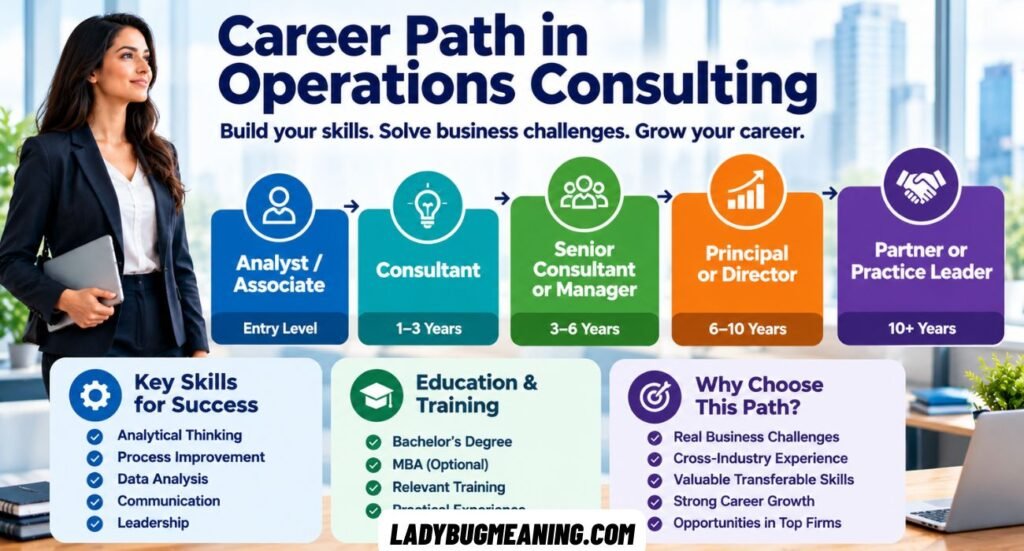
A bachelor’s degree in business administration, operations management, industrial engineering, supply chain management, economics, finance, or a related field can provide a useful foundation. Some employers also recruit graduates from other disciplines when they demonstrate strong analytical and problem-solving skills.
An MBA may be valuable for certain management consulting positions, particularly those involving business strategy, senior stakeholders, or leadership responsibilities. However, it is not universally required.
Professional training can also strengthen a candidate’s profile. Depending on the role, relevant learning areas include Lean management, Six Sigma, project management, business analytics, and supply chain planning. Specific certifications should be selected according to employer expectations and the candidate’s career goals.
Practical experience matters too. Internships, process improvement projects, operations roles, and analytical case studies can help candidates demonstrate that they know how to turn data into actionable recommendations.
Skills Needed
Successful operations consultants need a balanced combination of technical, analytical, and interpersonal skills.
Analytical thinking helps consultants break complicated problems into smaller questions, interpret business data, and identify root causes. They must distinguish meaningful patterns from incomplete or misleading information.
Process improvement skills help them map workflows, locate bottlenecks, reduce waste, and develop better procedures. Familiarity with methods such as Lean and Six Sigma can be useful when the project requires structured quality or efficiency improvements.
Data analysis supports evidence-based decisions. Spreadsheet modeling, dashboard development, and familiarity with business intelligence tools can help consultants evaluate costs, productivity, quality, and service levels.
Communication and stakeholder management are equally important. Consultants must explain their findings clearly, listen to employees, manage disagreement, and gain support from decision-makers.
Project management and change management help ensure that recommendations are implemented within the agreed scope. Even a technically strong solution can fail if employees do not understand the change or managers do not provide the necessary support.
Read more: Pedro Paulo Business Consultant: Leadership & Strategy Development
Typical Career Progression
Career paths differ between firms, but operations consultants commonly progress through several stages.
| Career stage | Typical responsibilities |
|---|---|
| Analyst or associate | Collect data, conduct research, build models, and support process analysis |
| Consultant | Analyze problems, develop recommendations, and manage defined workstreams |
| Senior consultant or manager | Lead project teams, coordinate stakeholders, and oversee implementation |
| Principal or director | Manage major client relationships, shape engagements, and guide complex programs |
| Partner or practice leader | Lead client accounts, develop business, and set consulting practice direction |
These titles are illustrative rather than universal. Some firms use different titles, and promotions depend on performance, business needs, and organizational structure.
Early-career professionals often spend substantial time gathering data and testing assumptions. More experienced consultants take greater responsibility for project delivery, client relationships, and business development.
The career can offer varied assignments and exposure to different industries, but it also has challenges. Client deadlines, travel, changing project demands, and the need to communicate difficult recommendations can create pressure. People considering this career should weigh those demands against their interests and preferred working style.
When Should a Business Hire an Operations Consultant?
A business may benefit from outside operational expertise when its current systems no longer support its goals. Hiring a consultant is not always necessary, but it can be useful when internal teams lack the time, experience, or independence needed to diagnose a problem.
Common warning signs include recurring delivery delays, rising operating costs, duplicated work, unclear employee responsibilities, frequent customer complaints, and inconsistent results across locations. Rapid growth can also expose weaknesses in processes that worked well when the company was smaller.
An operations consultant may be particularly helpful when a company is preparing to expand, introduce new technology, restructure departments, or improve performance across multiple sites.
Before hiring one, managers should define the problem as clearly as possible. A specific objective, such as reducing order-processing delays or improving inventory accuracy, is easier to evaluate than a general goal of making the business more efficient.
Businesses should also consider whether the problem can be solved internally. If an experienced employee can address a simple workflow issue, an external engagement may not justify the cost. If the challenge involves multiple departments, complex analysis, or significant organizational change, outside support may offer greater value.
How to Choose the Right Business Consultant
Choosing a consultant requires more than reviewing a service list or an attractive website. Businesses should evaluate the proposed work, relevant expertise, communication style, commercial terms, and evidence supporting any claims about results.
Evaluate the Problem-Solving Approach
A credible consultant should ask detailed questions about the business before recommending a solution. They should seek to understand the company’s goals, existing processes, available data, and practical constraints.
Be cautious of proposals that promise guaranteed savings or dramatic improvements without first examining the situation. Operational outcomes depend on many factors, including implementation quality, employee participation, market conditions, and the accuracy of the underlying information.
Review Experience and Deliverables
Ask for examples of relevant projects, references where available, and an explanation of the consultant’s role in each engagement. Distinguish between work the consultant personally completed and results achieved by a larger team.
The proposal should explain what the business will receive. Deliverables may include a diagnostic assessment, process maps, an improvement roadmap, implementation support, employee training, and performance reports.
Compare Fees and Expected Value
Consulting fees may depend on project duration, complexity, team size, and the level of specialist expertise required. Some consultants charge hourly or daily rates, while others offer fixed-fee engagements or longer-term advisory arrangements.
Compare the total cost with the expected business benefit, but avoid treating projected savings as guaranteed outcomes. A sound proposal explains its assumptions, identifies implementation costs, and shows how results will be measured.
Verify the Consultant’s Identity
When researching a PedroVazPaulo business consultant, confirm that the website, contact details, service description, and proposed agreement match the practice you intend to contact. The name appears across multiple domains online, so it is important not to assume that every similarly named website belongs to the same business.
The website presents business consulting, operations consulting, strategy, IT, and executive coaching services. Its published descriptions can help readers understand the advertised service scope, but marketing statements alone do not independently establish a consultant’s qualifications or results.
Before making a payment, verify the identity of the contracting party, review the written scope of work, clarify refund and cancellation terms, and confirm who will be responsible for delivering the services. These checks are useful when evaluating any consultant, not just a particular brand.
Measuring the Success of Operations Consulting
A consulting engagement should have clear measures of success. Without them, a business may struggle to determine whether new procedures or systems actually improved performance.
The most useful KPIs depend on the project’s purpose. A warehouse improvement project needs different measures from a customer service redesign or a manufacturing quality initiative.
| Business objective | Example KPI | What it measures |
|---|---|---|
| Reduce processing delays | Average processing time | How long a task takes |
| Improve delivery reliability | On-time delivery rate | The share of orders delivered as scheduled |
| Control operating costs | Cost per unit or transaction | The cost of producing or completing work |
| Improve quality | Defect or error rate | The frequency of mistakes |
| Improve inventory management | Inventory accuracy | How closely recorded stock matches actual stock |
| Strengthen customer service | Customer satisfaction score | Customer perceptions of service quality |
These indicators should be interpreted together rather than in isolation. For example, reducing staffing costs may improve short-term expenses while increasing delays or lowering service quality. A balanced evaluation considers cost, quality, speed, and customer outcomes.
Set a Baseline Before Making Changes
Before implementation, record the current performance level using reliable data. Agree on a target, a measurement period, and the person responsible for tracking progress.
Suppose a business processes 1,000 customer orders per month and regularly experiences avoidable errors. The consulting team might measure current error rates, identify the main causes, introduce standardized procedures, and compare the next several months of results with the baseline.
This example illustrates a measurement approach, not a claim about a real consulting engagement. Actual improvements must be established from the business’s own data.
Consider Long-Term Sustainability
An improvement is more valuable when the business can maintain it after the consultant leaves. Managers should monitor performance, update procedures, train new employees, and assign ownership of the new process.
The final review should document what changed, which targets were met, what remains unresolved, and whether additional action is necessary. This creates a practical record for future decisions and reduces the risk of returning to old habits.
See also: The Green Ladybug Spiritual Meaning
How PedroVazPaulo Business Consulting Relates to Operations Improvement
Businesses researching PedroVazPaulo may be interested in how operational efficiency connects with wider business strategy and leadership development. These areas often influence one another: a new workflow may require revised responsibilities, better management decisions, or changes to the technology a team uses.
The website describes a consulting practice that includes business and strategy consulting, IT consulting, operations consulting, and executive coaching.
For example, a growing company might need to document its processes, clarify departmental responsibilities, and introduce consistent performance reporting. An operations-focused engagement could address the processes, while leadership support could help managers communicate expectations and maintain accountability.
However, prospective clients should confirm which services are available for their specific needs, who will perform the work, what implementation support is included, and how outcomes will be assessed. The appropriate choice depends on the business problem rather than the consultant’s branding alone.
A useful starting point is to prepare a short problem statement, list the desired outcomes, and gather any available performance data. This helps both the business and the consultant determine whether a proposed engagement is practical and worthwhile.
FAQs About Operations Consulting
1. What does an operations consultant do?
An operations consultant analyzes business processes, identifies inefficiencies, and recommends practical improvements. The work may include cost optimization, workflow redesign, supply chain management, technology implementation, and performance measurement.
2. How can a PedroVazPaulo business consultant help a company?
The PedroVazPaulo website describes services covering business strategy, operations, IT consulting, and executive coaching. Businesses should confirm the specific deliverables, consultant qualifications, and implementation support available before entering an engagement.
3. What is the difference between strategy consulting and operations consulting?
Strategy consulting focuses on business direction, competitive positioning, and growth priorities. Operations consulting focuses on how the organization delivers its products or services efficiently. Many projects involve both disciplines because strategic plans require effective execution.
4. How much does operations consulting cost?
The cost depends on the consultant, project complexity, duration, and level of support required. Businesses should request a written proposal outlining fees, deliverables, assumptions, and any additional implementation expenses.
5. What qualifications do operations consultants need?
Many have degrees in business, engineering, economics, supply chain management, or related fields. Analytical skills, process improvement knowledge, communication, and project management experience are also valuable. Requirements vary by employer and specialization.
6. Which companies benefit most from operations consulting?
Startups, small businesses, growing companies, and large organizations can all benefit. It is especially useful when recurring inefficiencies, rising costs, operational bottlenecks, or expansion plans create challenges that internal teams struggle to resolve.
7. How long does an operations consulting project take?
A focused diagnostic or workflow review may take a few weeks, while a large operational transformation can take several months or longer. The timeline depends on project scope, data availability, organizational complexity, and implementation requirements.
8. How can a business measure the results of operations consulting?
Businesses can compare baseline performance with results after implementation. Useful measures include operating cost per unit, processing time, error rates, delivery reliability, productivity, and customer satisfaction. The selected metrics should match the original business objectives.
Conclusion
Operations consulting helps businesses improve processes, manage resources, control costs, and strengthen performance. The right consultant identifies the causes of operational problems, develops practical recommendations, and helps the organization measure progress. Companies should choose a provider based on relevant expertise, clear deliverables, transparent fees, and realistic expectations rather than impressive promises alone.
When evaluating a PedroVazPaulo business consultant, connect the proposed services to your company’s actual needs and verify the details before committing. Define measurable goals, agree on responsibilities, and track outcomes after implementation. A well-planned engagement can support more efficient operations, stronger management decisions, and sustainable business growth.