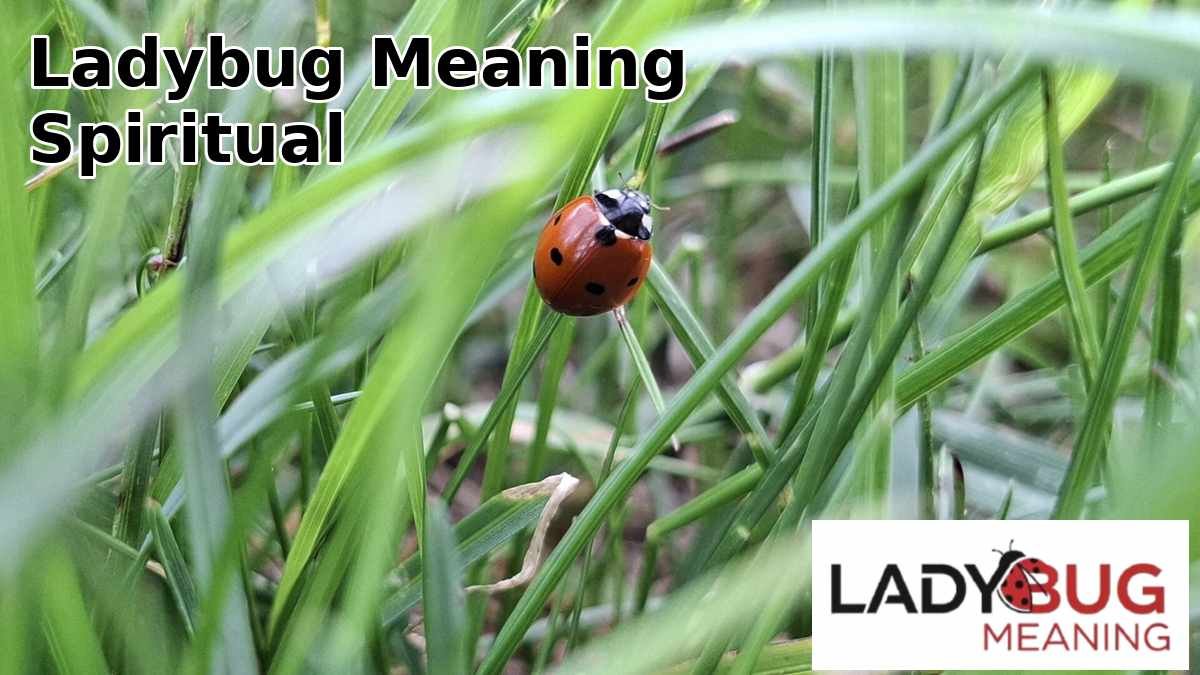
Ladybug Meaning Spiritual: Luck, Protection, Love and Renewal
The ladybug meaning spiritual writers, farmers and grandmothers have handed down is unusually consistent for a piece of folklore: luck, protection, love and renewal, all carried by a beetle small enough to rest on a fingernail. Almost nobody brushes one away unthinkingly. People smile, make a wish, and let it be.
That consistency is what makes the spiritual layer worth its own page. Read spiritually, a ladybug is never just an insect that wandered in: it is a small, kind messenger, and the moment of the meeting — where it lands, what you were turning over, what season your life is in — is where the meaning is read.
Our complete guide to ladybug meaning maps the whole subject: every encounter, colour and spot count, with the real beetle underneath. This page walks the spiritual side of that map in full — where the reading came from, the great themes it returns to, the wish customs, and what each kind of encounter is said to mean.
Ladybug Meaning Spiritual: The Quick Answer
Quick Answer: The ladybug meaning spiritual is a small, kind messenger: luck arriving quietly, protection over what you tend, love handled gently, and renewal after a hard season. The reading grew from a real gift: the beetle eats the aphids that eat the crops. Its oldest layer is a dedication to the Virgin Mary — Our Lady’s bird.
Everything below is that answer in full — the tradition first, with the beetle underneath it never hidden, and every layer labelled as what it is: documented custom, church dedication, or modern symbolism.
Where the Spiritual Meaning Comes From: Our Lady’s Beetle
Most luck symbols have forgotten origins. This one’s is written into the insect’s name. In Britain the beetle became known as “Our Lady’s bird” — the Lady being Mary, the mother of Jesus — and the dedication is recorded by Britannica and Wikipedia alike as the plain origin of the English name.
Notice who made the dedication: not theologians, but the people whose harvests the beetle decided. The spiritual meaning of this insect was built by its beneficiaries, season by season — which is why it has outlasted grander symbols built on nothing but appearance.
A Prayer Answered in the Fields
The famous story is told as folklore and is kept that way here: farmers, their crops being eaten by aphids, prayed to Mary for help — and the ladybirds came, and ate the pests. It is a story that explains a name rather than a recorded event, but it fits the beetle underneath it exactly.
The harvest fact beneath the story is measured, not mythical. Britannica records a single convergent ladybug larva eating 300 aphids in two weeks, and an adult female devouring several thousand across her life. A field full of ladybirds was a field whose pests were being eaten — the luck began as an observation.
The Seven Spots and the Red Cloak
Mary was painted in a red cloak in early art, and the common species wore her colour. The seven-spot ladybird’s seven spots were matched to her seven joys and seven sorrows — a devotional association the Royal Entomological Society records among others, and the reason the beetle reads, in the old countries, almost like a small rosary that walks.
One boundary belongs here, stated plainly: no verse in the Bible names the ladybug. The King James text names a beetle exactly once, in the Leviticus list of insects that may be eaten, and it is not this one. The Christian connection is medieval devotion — a naming tradition, not a scripture.
Names of Honour Around the World
The dedication survives across Europe’s languages. German keeps Marienkäfer, “Mary’s beetle,” and an old French name is bête à bon Dieu, “the good Lord’s creature.” A Swedish name, Himmelska nyckla, means “Keys of Heaven” — Christian folk belief treated the beetles as heaven’s own gatekeepers.
The honours are wider than one faith. Jewish tradition knew the same beetle as the “Cow of Moses our Teacher,” and the Cherokee revered it as the “Great Beloved Woman,” a title carried by the highest-ranking woman in their government, painted in its colours for ceremonies. In Turkey it is simply uğur böceği — “good luck bug.”
Luck: The Founding Meaning
Luck is the oldest theme in the tradition, and the only one that began as an observation rather than a metaphor. Ladybirds ate the aphids eating the crop, the harvest improved, and the beetle was credited — first with gratitude, then with reverence, and finally with the power to announce good fortune wherever it appeared.
From that working fact, the reading widened: a ladybug’s arrival came to be taken as a blessing on its way, in whatever department of life the finder happened to need one. The tradition has kept that shape ever since — the luck is real help, arriving at beetle scale, and it is noticed or missed in a moment.
The Customs That Carry the Luck
The customs are the luck in working clothes. Never harm a ladybug: many traditions held that harming one was the surest way to turn your own fortune. And never brush one off — brushing discarded the gift. The beetle is allowed to leave in its own time, on its own wings.
While it stays, you may use the moment: make a wish as it settles, and count its spots. An old European custom counted a landing ladybug’s spots as the number of lucky months ahead — the count was the ritual, and children performing it on a fingertip are carrying an unbroken rite.
Protection: A Small Guard, Posted
A creature this small, this slow and this apparently defenceless, which nevertheless thrives on every continent, invites a guardian reading. In the tradition, a ladybug near your door, your plants or your person is read as a small guard posted there: what you value is being looked after, and the help is near enough to see.
The beetle earns the reading twice over. For itself, it carries warning colours and bitter blood — a disturbed ladybird squeezes a drop of foul-tasting fluid from its leg joints, and a bird that mouths one learns the pattern for life. For the garden, it gives a lifetime of pest control. Protection that does not need to shout.
The guard reading gathers at thresholds. In old European folklore the bright shell was said to carry light into a house and turn harm aside, and a beetle near a door or window was welcomed rather than swept out for exactly that reason — a watch kept at the boundary of the home.
Love: The Gentle Register
Love enters the tradition through the matchmaking customs, and it keeps their manners. In Europe, a ladybug let go from a young woman’s hand was said to fly toward her future partner — the beetle consulted as a compass for the heart, its direction read as the answer.
A French custom counted time instead of direction: the moments recited aloud until the beetle flew were said to tell the years until a marriage. Both customs share the tradition’s signature — the beetle is never seized or kept. It is released, and the reading is taken from its leaving.
Read today, the ladybug in love means affection that arrives without force: timing, tenderness, and care given to a bond that is already growing. It is love’s light register, measured in small attentions rather than grand gestures — a flirtation that lands gently, a reconciliation that arrives unforced.
Renewal: The Self Mid-Change
The beetle’s own biography carries this theme. Egg, larva, pupa, adult — nothing in the sequence resembles the stage before it, and the finished beetle even spends its first hours pale and unmarked before its colours arrive. Symbolism writers lean on that arc hard, and it bears the weight.
Read spiritually, a ladybug sighting during a stuck or hidden stretch of life is taken as the picture of that arc from inside: a change that looks like nothing while it is happening, and like renewal when it is done. The encouragement is precise — a self mid-change is not lost, only unfinished.
Winter, Then Spring
The endurance underneath the reading is real. Ladybirds overwinter as adults, often gathered in large groups in sheltered places, and come out in spring to start again. The tradition borrows that patience for its readers: a hard season is a season, and seasons turn.
That is why renewal sits beside luck at the centre of the spiritual reading. The beetle does not merely announce that things can change; it has done the changing itself, in the open, at seven millimetres — and then slept through the winter and begun again.
Ladybugs at Life’s Turning Points
The moment does half the reading, and the biggest moments attract the beetle most often in people’s stories. A ladybug in the weeks of a new baby is read as the renewal theme at its most literal: new life, gently guarded, arriving after a hidden season of growth.
After a loss, the same beetle is read as comfort rather than omen: life continuing at small scale — colour, appetite and patience, carrying on in a garden the person loved. The tradition offers no darker reading of a living ladybug, and never has.
These moment readings are the tradition’s modern layer, and they are honest ones: the meaning is assigned by the moment, not delivered by the insect. What the beetle guarantees is only the encounter. What it means is fitted, as it always has been, by the finder.
The Wish Customs: What People Actually Do
The wish is the tradition’s most practised ritual, and its form is centuries old. A ladybug settles on you; while it stays, you make a wish; when it flies, the wish is said to be carried off with it. Some tellings add a gentle breath to send it on its way — the wish travels because the beetle does.
The nursery rhyme belongs to the same custom, and it carries real history. “Ladybug, ladybug, fly away home” is sung to send a found beetle on its way, and Britannica notes that the rhyme refers to the burning of hop vines in England after the harvest, when the beetles had to scatter.
The etiquette around the wish is the kindness the whole tradition runs on. Never crush the beetle — its defensive blood smells and stains, quite apart from the old rule against harming one. Coax it onto a card or a leaf, carry it to a plant, and let it step off and return to its work.
Spiritual Meaning by Encounter
Context is the tradition’s own rule: where and how you meet the beetle changes the reading, and the ladybug meaning spiritual readers look for is always fitted to the moment. Here are the encounters in brief — each one has a full treatment of its own elsewhere in this cluster, linked as you go.
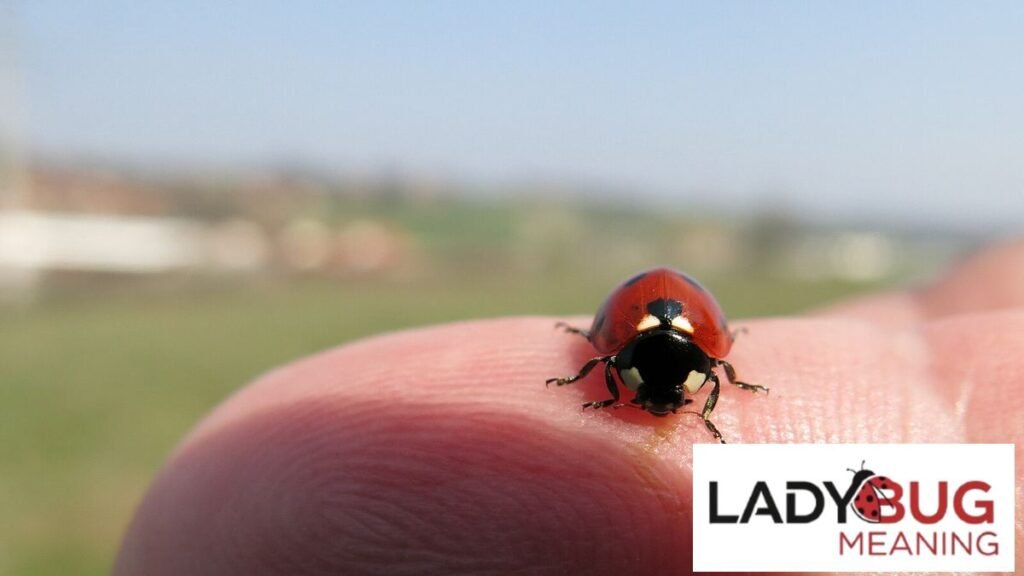
When a Ladybug Lands on You
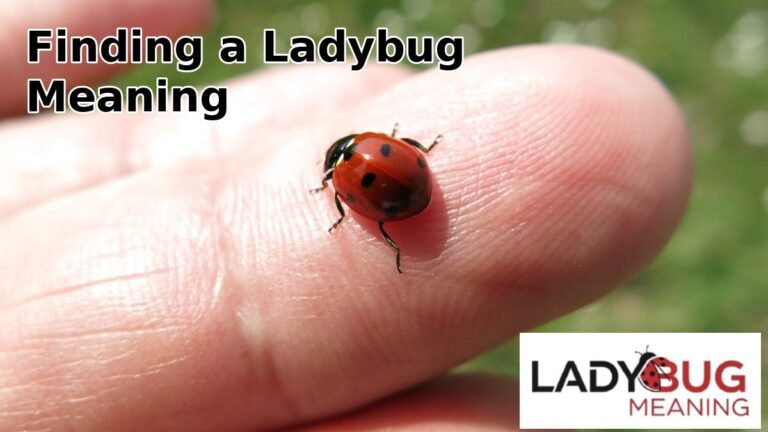
This is the classic encounter, and the one with the deepest roots: a blessing that found you, delivered in person. Make a wish before it flies, and let it leave in its own time. Our full guide to a ladybug landing on you covers the readings by body part and the custom’s history.
Seeing a Ladybug — and Seeing Them Again and Again
A single sighting carries the general blessing: luck, protection, a moment worth noticing. Repeat sightings are read as emphasis — a season of noticing, help around you, the same kind message arriving until it is received. The full encounter is treated in our guide to seeing a ladybug.
A Ladybug in the House
One beetle indoors is read as protection over the home — a welcome guest, and in autumn, a house chosen as a safe place to rest. The room-by-room readings and the plain shelter story behind the autumn gatherings fill our guide to a ladybug in the house.
A Ladybug in a Dream
Dreaming of a ladybug is read as good things being tended out of sight: luck forming, protection felt during a vulnerable stretch, a small joy on its way. Dream readings are the softest layer of the tradition — modern symbolism, honestly labelled. The scenarios are mapped in our ladybug dream meaning guide.
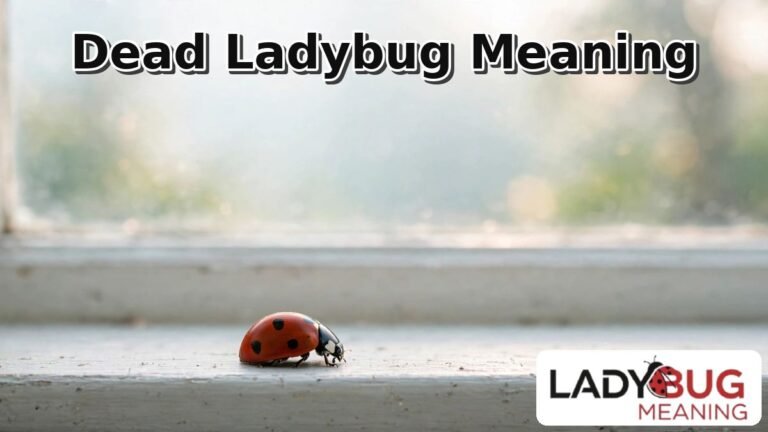
Finding a Dead Ladybug
The tradition is kinder than the finder’s first feeling: a dead ladybug is read as completion, not punishment — a protective season ending, a blessing that has done its work, something ready to be released. Our guide to the dead ladybug gives this closing encounter its full reading.
Spiritual Meaning by Colour
Two things are true at once: a ladybug’s colour mostly tells you which species you saw, and modern spiritual readers have given each colour a meaning of its own. The readings below are that modern layer, labelled as such, and the beetle column keeps the identification honest.
| Colour | Read spiritually as | Usually the beetle | Full guide |
|---|---|---|---|
| Red | Vitality, love and protection — the luck colour itself | The seven-spot ladybird and other classic red species | Red ladybug meaning |
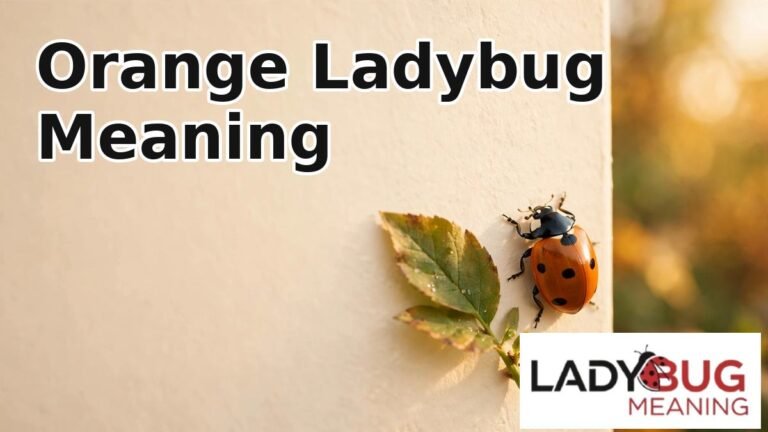
| Orange | Creative movement, encouragement, effort turning into results | Frequently the Asian lady beetle; Britain also has a true orange ladybird with white spots | Orange ladybug meaning |
| Yellow | Optimism, clarity and new beginnings | The 22-spot and 14-spot ladybirds — or a cucumber beetle impostor | Yellow ladybug meaning |
| Green | Growth, healing and renewal | Almost never a ladybird — usually a cucumber beetle | Green ladybug meaning |
| Brown | Grounding, patience and quiet stability | Tree species such as the larch and cream-spot ladybirds | Brown ladybug meaning |
| Black | Inward steadiness, boundaries, strength held quietly | Black forms of the Asian lady beetle; the twice-stabbed lady beetle is shiny black with two red spots | Black ladybug meaning |
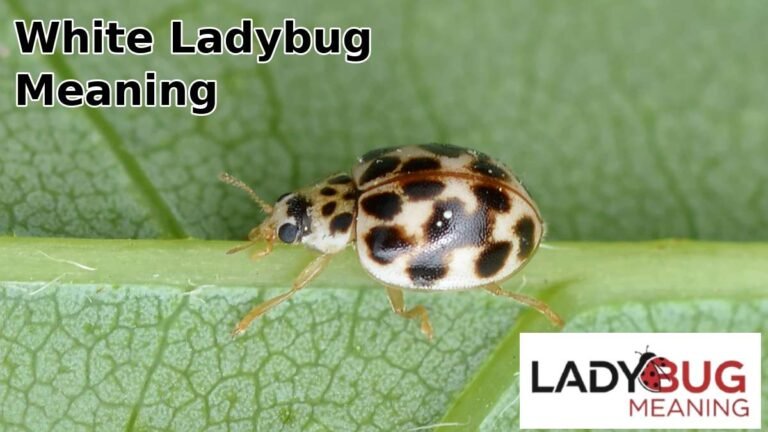
| White | Purity, clarity and a fresh start | The fifteen-spotted and ashy gray lady beetles — or any ladybird in its first pale hours | — |
The colour readings are the youngest layer of the whole tradition, and the table is built to keep them honest: every modern meaning sits beside the species record, so a reader can hold the reading and the beetle at the same time, and never has to mistake one for the other.
Why Ladybugs Actually Appear: The Beetle’s Own Reasons
The spiritual reading never has to pretend to be biology, because the biology is plain and interesting on its own. Ladybugs turn up in lives for reasons of food, warmth and shelter — and knowing those reasons takes nothing away from the moment. It simply keeps the two shelves separate, as this site keeps them everywhere.
Food, in Spring and Summer
Ladybirds appear where the aphids are. They breed through late spring and summer, generations follow the pest colonies, and in a good aphid season the beetles are simply abundant — which is why repeat sightings cluster in the same weeks. A summer rich in ladybirds is, in plain fact, a garden whose pests are being eaten.
Shelter, in Autumn and Winter
From autumn onward the engine changes: adult ladybirds look for a sheltered crevice to sleep the winter in.
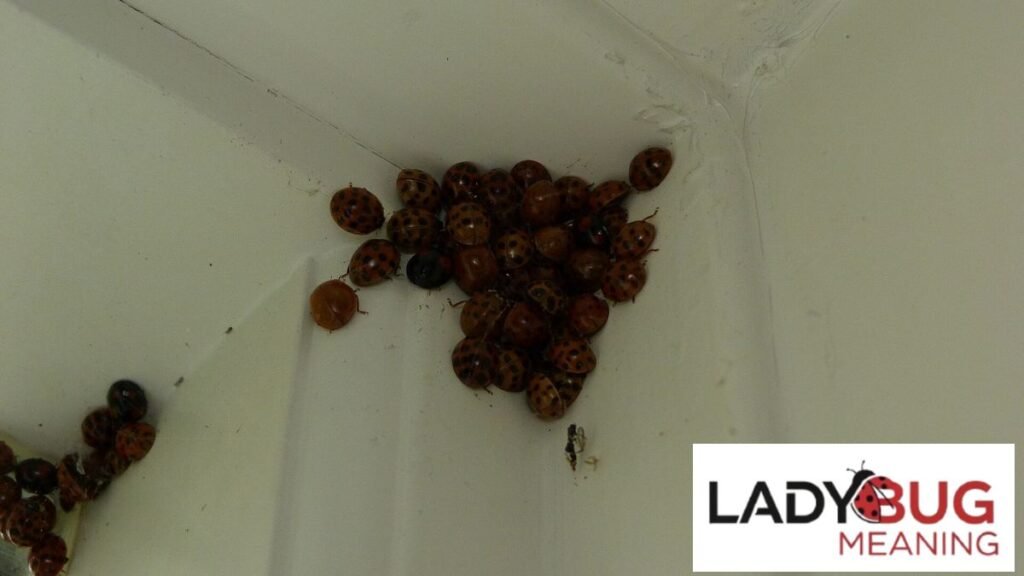
University of Minnesota Extension notes that the autumn gatherings around buildings are very often Asian lady beetles seeking that shelter, and that they do not breed indoors. A beetle on a warm January windowsill came in last fall and woke in the warmth.
Warmth and Landmarks, at Any Season
A ladybird in flight navigates by landmarks in daylight, and a warm, upright, sunlit surface — a sleeve, a shoulder, a hand, a car roof — is simply a good place to set down. And the palest encounters have the plainest cause of all: every new adult emerges soft and spotless, its pattern printing through over its first hours.
The Ladybug as a Spirit Animal
As a totem or spirit animal — in the modern sense of a recurring guide-figure a person identifies with — the ladybug is assigned to people in transition: the restarting and the quietly rebuilding. Its qualifications are the ones this page keeps circling: it transforms completely, protects what it lands on, and endures the winter in company.
The reading promises no rescue. It offers a temperament to borrow — small, persistent, bright, and patient with the hidden stages — and for many readers that is the most usable form the spiritual meaning takes: not a prediction, but a posture.
Frequently Asked Questions
What is the spiritual meaning of a ladybug?
Luck, protection, love and renewal: a messenger saying that help is near, what you are tending is protected, and a hard season is turning. It is folklore and belief — grown, unusually, out of the beetle’s work of eating the pests that eat the crops.
What does it mean spiritually when a ladybug lands on you?
Tradition reads it as a blessing that found you — the sign at its most personal. Make a wish while it stays, and let it fly in its own time: brushing it off was said to brush the luck away too. The custom is centuries-old folklore.
Are ladybugs good luck spiritually?
Yes — in the folklore most people know, the ladybug is among the best-loved luck signs in the Western world. The belief began on the farm, where ladybirds ate crop pests and harvests improved; the beetle has been treated as protected, and lucky, ever since.
What does a ladybug in the house mean spiritually?
One visitor is read as protection over the home; an autumn cluster means your house was chosen as a safe place. Plainly, indoor ladybugs are sheltering for winter — often Asian lady beetles — and they do not breed indoors. Both readings can be held at once.
What does it mean spiritually to keep seeing ladybugs?
The tradition reads repetition as emphasis: a season of noticing, help around you, a message arriving until it is received. The plain account runs beside it — ladybirds are abundant in aphid season, so repeat sightings are commonest exactly when the gardens are fullest.
What does a dead ladybug mean spiritually?
Completion, not a curse: a protective season ending, a blessing that has done its work, something ready to be released. Most dead ladybugs found indoors simply reached the end of their natural life after sheltering through the winter in the house.
Is the ladybug mentioned in the Bible?
No. No Bible verse names the ladybug, and the one beetle the King James text mentions is a food insect in Leviticus. The ladybug’s Christian connection is the medieval naming tradition — “Our Lady’s bird,” dedicated to the Virgin Mary — not scripture.
What does a yellow ladybug mean spiritually?
In the modern colour readings, yellow is optimism, clarity and new beginnings — the brightest of the colour meanings. The beetle underneath is usually a 22-spot or 14-spot ladybird, two small species that wear yellow for life; it can also be a cucumber beetle impostor.
Conclusion
The spiritual meaning of the ladybug, held up to the light, is one idea in many colours: small help, faithfully given, protects what grows. Its root was real — a beetle that saved harvests — and everything the tradition built on that root, from a saint’s name to a child’s wish, was built in gratitude.
So when one finds you, take the tradition’s advice: notice it, receive it, and let it go on its way. And if the insect underneath the symbol draws you in — its species, its defences, its double life as beetle and blessing — the encyclopedia’s account of the lady beetle family is the place to wander next.