
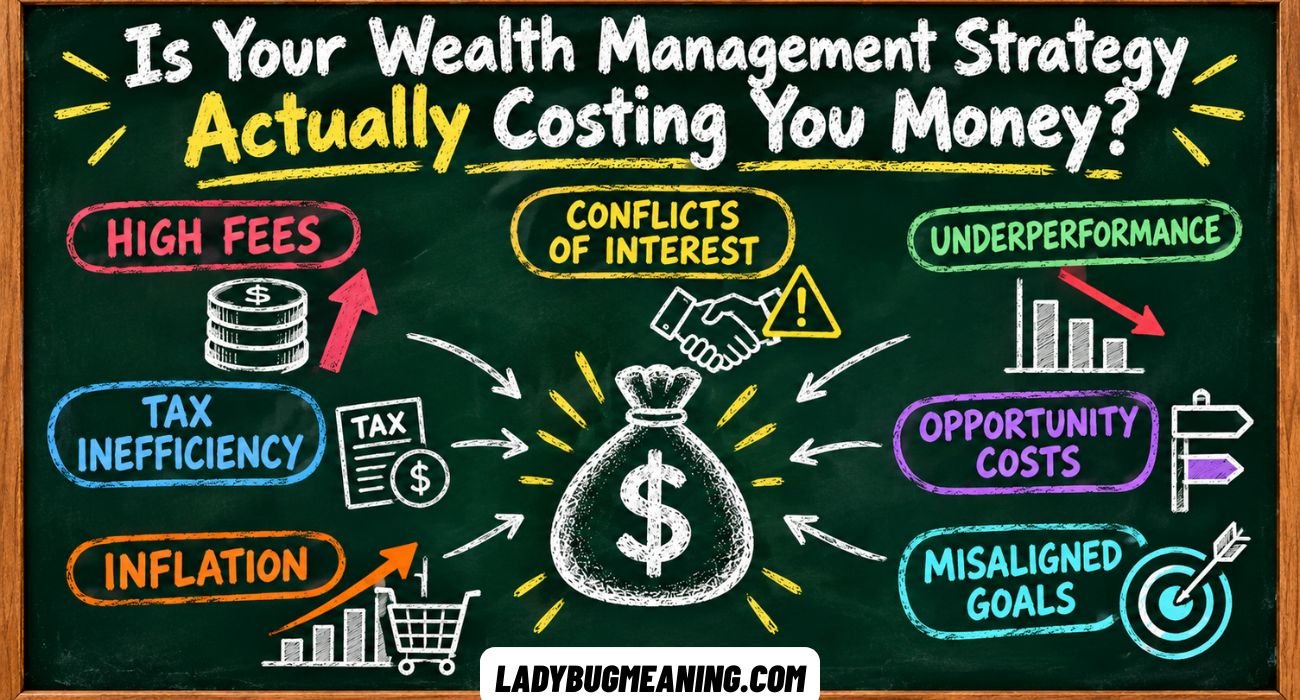
Is Your Wealth Management Strategy Actually Costing You Money?
Building wealth is not only about earning more or finding investments with attractive returns. It is also about controlling the costs, taxes, risks, and missed opportunities that can quietly reduce your long-term results. Anyone researching pedrovazpaulo wealth investment should therefore look beyond investment selection and consider how an overall wealth strategy creates or preserves value.
A wealth management plan may appear successful because an account balance is growing. Yet growth alone does not show whether the strategy is efficient. Advisory charges, fund expenses, unnecessary trading, taxes, inflation, and poor asset allocation can consume a meaningful part of an investor’s returns over time.
The right question is not simply, “Did my portfolio make money?” A better question is, “Did my portfolio deliver an appropriate return for the risk, taxes, fees, and alternatives available to me?” This guide explains how to evaluate those factors and recognize when wealth management may be costing more than it provides.
Read also: How Strategy Consulting Can Transform Your Business
The True Cost of Wealth Management Services

Wealth management costs can extend well beyond the number shown on an advisor’s invoice. Depending on the arrangement, investors may encounter an assets-under-management fee, fixed planning fee, hourly charge, commissions, fund expenses, transaction costs, custody expenses, or a combination of several charges.
An assets-under-management, or AUM, model generally charges a percentage of the assets an advisor manages. The important issue is not whether a particular pricing model is automatically good or bad. It is whether the total price is reasonable for the planning, portfolio management, tax coordination, risk management, and other services actually being provided.
Fund expenses deserve attention as well. Mutual funds and exchange-traded funds can have internal operating expenses that are separate from an advisor’s fee. Certain investments may also involve sales charges, performance fees, surrender charges, or other costs.
That makes total cost more useful than looking at a single fee.
| Potential Cost | What It Covers | What to Check |
|---|---|---|
| Advisory fee | Portfolio management and/or financial advice | Percentage or fixed amount and services included |
| Fund expense ratio | Operating costs of a fund | Annual percentage charged within the fund |
| Commissions | Buying or selling certain products | Frequency and incentive structure |
| Trading costs | Portfolio transactions | Whether turnover is necessary |
| Planning fee | Financial planning services | Scope and frequency of planning |
| Tax cost | Taxes triggered by investment decisions | After-tax rather than only pre-tax results |
Ask for a clear explanation of every layer of cost. A transparent advisor should be able to explain what you pay, who receives the money, and what services or products generate each charge.
How Small Fees Can Become Large Long-Term Costs
Investment costs deserve attention because compounding works in both directions. Returns can compound over time, but money removed through recurring fees no longer remains invested to generate future returns.
Consider a simplified illustration. Suppose two hypothetical portfolios both earn 7% annually before fees. One loses 0.50% each year to total costs, leaving a hypothetical 6.5% return, while another loses 1.50%, leaving 5.5%.
With a starting investment of $500,000 and no additional contributions or withdrawals, the mathematical difference after 20 years would be substantial:
| Hypothetical Scenario | Net Annual Return | Approx. Value After 20 Years |
|---|---|---|
| Lower-cost portfolio | 6.5% | $1.76 million |
| Higher-cost portfolio | 5.5% | $1.46 million |
| Approximate difference | — | $300,000 |
This is an illustration, not an investment forecast. Actual returns fluctuate, taxes vary, and fees can change. Its purpose is to demonstrate why seemingly small annual cost differences deserve examination when evaluating a long-term wealth strategy.
Costs should not be minimized at the expense of quality, either. Paying more can be reasonable when an advisor provides valuable financial planning, behavioral guidance, estate coordination, tax-aware decisions, or other services that justify the additional expense.
When Your Advisor’s Interests Don’t Align With Yours
A strong financial relationship depends on understanding how an advisor is compensated and what incentives may influence recommendations.
Potential conflicts can arise when compensation changes depending on the investment product recommended, when proprietary products are favored, or when an advisor receives commissions or other financial benefits from particular transactions.
That does not automatically make a recommendation unsuitable. It does mean investors should understand the conflict before deciding.
One useful question is whether the advisor is required to act as a fiduciary when providing advice to you. A fiduciary obligation generally involves acting in the client’s best interest rather than putting the advisor’s financial interests ahead of the client’s.
Investors can ask direct questions such as:
- Are you acting as a fiduciary when advising me?
- How are you compensated?
- Do you receive commissions or other payments from third parties?
- Do you recommend proprietary investment products?
- What conflicts of interest should I know about?
- How does this recommendation benefit my financial plan?
- Is there a less expensive alternative that could serve the same purpose?
Written disclosures and regulatory records can provide additional information. In the United States, investors can research investment advisers through the SEC’s Investment Adviser Public Disclosure system and brokerage professionals through FINRA’s BrokerCheck.
Underperformance: The Silent Wealth Killer
A portfolio can make money and still perform poorly.
Imagine an investment account increases by 5%. That sounds positive until you discover that a reasonable benchmark for a similarly risky portfolio performed significantly better during the same period. Even then, one year’s comparison is rarely enough to judge a strategy because investment styles move in and out of favor.
Performance should instead be considered over appropriate periods and in context.
Compare Performance With the Right Benchmark
Benchmark selection matters. Comparing a conservative portfolio containing bonds and stocks against an all-stock index can create a misleading impression. The comparison should reflect the portfolio’s asset allocation, investment objective, and risk profile.
For diversified portfolios, evaluating the individual components or using an appropriately blended benchmark may provide a more meaningful comparison.
Look at Risk, Not Only Return
Higher returns are not automatically better if achieving them requires taking far more risk than the investor can tolerate.
An effective review therefore considers volatility, diversification, concentration, drawdowns, investment horizon, and the investor’s financial objectives alongside performance.
A retiree depending on portfolio withdrawals, for example, may reasonably prioritize capital preservation and income differently from a 30-year-old investor accumulating wealth for retirement.
Focus on After-Fee Results
Gross investment performance can hide an important part of the story.
Investors should determine what remains after investment expenses and advisory costs. Where applicable, examining after-tax results provides an even clearer view of the wealth actually retained.
For someone assessing pedrovazpaulo wealth investment, this broader framework is more useful than concentrating on headline returns alone.
Tax Inefficiency in Your Wealth Strategy

Investment returns do not exist independently of taxes. Two portfolios generating similar pre-tax returns can produce different outcomes after taxes.
Tax implications can arise from interest income, dividends, capital gains, portfolio turnover, distributions from funds, and withdrawals from different account types. The rules depend heavily on jurisdiction and individual circumstances.
Asset Location Can Matter
Asset allocation answers the question, “What investments should I own?”
Asset location asks, “Which type of account should hold them?”
Depending on the investor and applicable tax rules, certain investments may be more tax-efficient in taxable accounts, while others could be better suited to tax-advantaged accounts. There is no universal arrangement that works for everyone.
Excessive Turnover May Create Tax Consequences
Frequent buying and selling can create realized gains in taxable accounts. A strategy that constantly trades must therefore produce enough additional value to compensate for its potential trading costs and tax consequences.
Low turnover is not automatically superior, and selling can sometimes be necessary for risk management, rebalancing, or financial planning. The key is whether transactions have a clear purpose.
Tax-Loss Harvesting Requires Care
Tax-loss harvesting generally involves selling an investment at a loss to potentially offset taxable gains, subject to the applicable tax rules.
It can be useful in certain situations, but it should not become the main reason for making investment decisions. Rules concerning replacement investments and loss recognition can be complex. Investors should consider qualified tax advice for their individual circumstances.
Opportunity Costs You’re Probably Ignoring
Opportunity cost is the potential benefit you give up by choosing one financial option instead of another.
Suppose an investor holds an unusually large cash balance for years despite having a long investment horizon and sufficient emergency reserves. The visible balance remains stable, but inflation may reduce its purchasing power, while the investor also gives up potential returns available from investments that match their objectives and risk tolerance.
Opportunity cost can appear in other ways.
An overly conservative allocation may limit long-term growth. Excessive concentration in one company or industry may expose wealth to unnecessary risk. High-cost products may consume money that could remain invested. Holding unsuitable investments for tax reasons alone may create a different kind of cost.
Even inactivity has a price when it results from neglect rather than an intentional financial plan.
The objective is not to chase every opportunity. A disciplined investor accepts that some investments will outperform others. The goal is to make deliberate choices consistent with financial objectives rather than allowing hidden trade-offs to shape the portfolio accidentally.
Read more: PedroVazPaulo Business Consultant
Inflation: The Cost That Doesn’t Appear on Your Statement
An account statement normally shows dollars, not purchasing power.
If an investment grows by 4% while the general cost of goods and services rises significantly, the investor’s improvement in purchasing power is smaller than the nominal return suggests.
This difference makes real return an important concept:
Real return ≈ investment return − inflation
The exact relationship is slightly more complex mathematically, but this approximation illustrates the principle.
Inflation risk becomes particularly important for long-term objectives such as retirement. Holding too much wealth in low-return assets may feel safe because the account value fluctuates less, yet purchasing power can gradually decline.
An effective wealth strategy balances market risk against inflation, liquidity needs, time horizon, and the investor’s ability to tolerate losses.
Is Your Portfolio More Complicated Than It Needs to Be?
Complexity can sometimes be necessary. High-net-worth households may have businesses, trusts, concentrated stock positions, real estate, multiple tax jurisdictions, estate-planning requirements, or other circumstances requiring sophisticated solutions.
But complexity should solve a problem.
Owning many funds does not automatically create better diversification. Several funds may hold many of the same securities, creating portfolio overlap without the investor realizing it.
Complex products can also make fees, liquidity restrictions, risks, and performance harder to understand.
Ask a simple question about every major holding:
What specific job does this investment perform in my portfolio?
A clear answer might be long-term growth, income, capital preservation, diversification, liquidity, or exposure to a particular asset class.
If neither the investor nor the advisor can clearly explain an investment’s purpose, costs, major risks, and role in the portfolio, further review may be warranted.
How to Audit Your Wealth Management Strategy
Evaluating wealth management does not require predicting which investment will perform best next year. A structured review can reveal whether the overall system makes sense.
Start by calculating your total investment-related costs rather than looking only at the advisor’s headline fee. Include advisory charges, underlying fund expenses, commissions, and other recurring costs that apply.
Next, compare long-term performance against benchmarks appropriate for your portfolio’s asset allocation and risk. Examine results after relevant fees rather than relying solely on gross performance figures.
Review tax efficiency where applicable. Look at portfolio turnover, realized gains, distributions, and how different account types are being used.
Then evaluate diversification. Identify excessive exposure to individual securities, industries, countries, asset classes, or other concentrated risks.
Finally, reconnect the portfolio to its purpose. Your investment strategy should reflect your goals, expected withdrawals, time horizon, liquidity requirements, tax circumstances, and capacity to accept losses.
A useful annual review can focus on five questions:
| Review Area | Core Question |
|---|---|
| Costs | What am I paying in total? |
| Performance | Am I getting reasonable results for the risk taken? |
| Taxes | Are avoidable tax costs reducing my results? |
| Portfolio | Does each major holding have a clear purpose? |
| Goals | Does the strategy still support what I need my money to accomplish? |
DIY Investing vs. Robo-Advisors vs. Traditional Wealth Management
Traditional wealth management is only one approach. The appropriate option depends on portfolio complexity, knowledge, available time, behavior during volatile markets, and the amount of financial planning required.
| Approach | Potential Advantage | Potential Limitation | Often Suitable For |
|---|---|---|---|
| DIY investing | Greater control and potentially lower costs | Requires knowledge, discipline, and time | Confident, hands-on investors |
| Robo-advisor | Automated portfolio management and convenient rebalancing | Less personalized for complex circumstances | Investors with relatively straightforward needs |
| Financial planner | Broader financial guidance | Costs vary considerably | People needing planning beyond investments |
| Wealth manager | Integrated advice for complex financial situations | Can be more expensive | Households with substantial or complicated finances |
Cost should be considered alongside value. A low-cost approach that causes an investor to panic-sell during market declines may ultimately prove expensive. Conversely, paying premium wealth-management fees for little more than a basic portfolio may offer poor value.
Red Flags That Your Wealth Strategy Needs a Review
One disappointing year does not necessarily mean a wealth strategy has failed. Markets fluctuate, and a properly designed long-term portfolio will experience periods of decline.
More meaningful warning signs include persistent difficulty understanding what you pay, investments whose purpose cannot be explained, recommendations dominated by products that financially benefit the seller, excessive portfolio turnover without a clear rationale, or performance discussions that consistently avoid appropriate benchmarks.
Communication matters too. Your advisor should be able to explain important decisions in understandable language.
Be cautious of anyone promising guaranteed high investment returns, presenting normal market investments as virtually risk-free, pressuring you to act immediately, or discouraging independent verification. Legitimate investing involves uncertainty, and risk should be discussed openly.
See also: Belly button itching spiritual meaning meaning
Evaluating PedrovazPaulo Wealth Investment in Context
Anyone researching pedrovazpaulo wealth investment should apply the same due-diligence standards they would use for any investment-related service, strategy, or provider.
Start by establishing exactly what is being offered. Is it financial education, investment consulting, portfolio management, business advisory work, or another service? These activities are not interchangeable, and regulatory requirements can differ.
Do not rely solely on marketing descriptions. Verify the legal entity involved, the professionals responsible for financial recommendations, applicable registrations or licenses, fee arrangements, conflicts of interest, investment methodology, custody arrangements, and written disclosures where relevant.
Most importantly, distinguish between general information and individualized investment advice. A strategy suitable for one investor may be inappropriate for another because of differences in age, income, tax position, financial obligations, risk tolerance, investment horizon, and goals.
For significant investment decisions, independent verification and advice from appropriately qualified financial and tax professionals can provide an additional layer of protection.
FAQs
What are the typical fees charged by wealth management advisors?
Wealth managers may use percentage-of-assets fees, fixed fees, hourly charges, commissions, or combinations of these models. Investors should also examine underlying fund expenses and other product or transaction costs. The total cost matters more than any single advertised fee.
How can I determine if a wealth management strategy is cost-effective?
Calculate your total costs and compare them with the services received. Then assess appropriate benchmark performance, risk, tax efficiency, financial planning support, and progress toward your goals. A strategy should be evaluated on net value rather than investment returns alone.
What are the alternatives to using a traditional wealth management advisor?
Alternatives include self-directed investing, robo-advisors, fee-only financial planning, and hybrid advisory services. The right choice depends on the complexity of your finances, investment knowledge, time, desired level of assistance, and ability to remain disciplined during market volatility.
How important is it for my financial advisor to be a fiduciary?
A fiduciary standard can provide an important layer of protection because it requires the advisor, when that duty applies, to put the client’s interests ahead of their own. Investors should ask whether and when an advisor acts as a fiduciary and request relevant disclosures in writing.
What steps can I take to reduce the costs of wealth management?
Start by identifying every fee you currently pay. Review fund expenses, advisory charges, unnecessary trading, overlapping investments, and expensive products. Lower costs should not be pursued blindly; compare any savings with the services and financial value you would give up.
How often should I review my wealth management strategy?
A comprehensive review at least periodically, and commonly annually, can help keep the strategy aligned with your circumstances. Additional reviews may be appropriate after major changes such as retirement, marriage, inheritance, business sales, significant tax changes, or major shifts in financial goals.
Is investment underperformance always a reason to change advisors?
No. Short-term underperformance can occur even with a sensible strategy. Evaluate performance over an appropriate period against a relevant benchmark while considering risk, fees, taxes, and your objectives. Constantly switching strategies based on recent performance can create additional problems.
What should I verify before using an investment or wealth management service?
Verify who provides the service, how they are compensated, what regulatory obligations apply, where assets are held, what fees you will pay, and what conflicts exist. When applicable, check registration and disciplinary information through the appropriate financial regulator.
Conclusion
A successful wealth strategy is measured by more than whether an account balance increased. Fees, taxes, inflation, inappropriate risk, conflicts of interest, underperformance, and opportunity costs can all influence how much wealth an investor ultimately keeps. Understanding these factors makes it easier to separate genuine financial value from unnecessary expense.
When evaluating pedrovazpaulo wealth investment or any other wealth-related approach, focus on transparency, total costs, appropriate risk-adjusted performance, tax awareness, diversification, and alignment with your financial objectives. Verify investment professionals and important claims independently before committing capital. The strongest strategy is not necessarily the most complicated or cheapest; it is one whose costs, risks, purpose, and potential benefits you can clearly understand.