

Marketing Consulting Essentials 101: Everything You Need to Know
Marketing plays an important role in helping businesses attract customers, build brand awareness, and increase revenue. However, many companies struggle to choose the right marketing channels, understand customer behavior, and measure campaign results. This is where marketing consulting can help. Pedrovazpaulo marketing consulting is a search term associated with exploring marketing consulting services, business growth strategies, and professional guidance for improving marketing performance. Readers should verify the provider’s current services, experience, and credentials before making a hiring decision.
Whether you run a small business, manage an established company, or want to become a marketing consultant, understanding the fundamentals can help you make better decisions. This guide explains what marketing consultants do, the skills they need, their main responsibilities, and the steps involved in building a successful consulting career. It also covers how businesses can evaluate consultants, measure marketing performance, and turn strategic recommendations into practical results.
Read also: PedroVazPaulo business consulting
Understanding the Role of a Marketing Consultant
A marketing consultant helps a business understand its market, reach the right audience, and develop strategies that support its commercial goals. Rather than relying on guesswork, a consultant evaluates available information, identifies opportunities, and recommends actions based on customer needs, competition, budget, and business objectives.
Marketing consultants may work independently, join consulting firms, or specialize in a particular industry or marketing channel. Some focus on brand positioning and market research, while others concentrate on search engine optimization (SEO), digital advertising, content marketing, email campaigns, or customer retention.
The scope of the work depends on the client’s needs. A new business might need help identifying its target audience and creating a launch strategy. An established company might need to improve conversion rates, reduce wasted advertising spending, or understand why customer growth has slowed.
Definition and Scope
Marketing consulting is a professional service that helps organizations plan, implement, and evaluate marketing activities. A consultant studies the company’s current position, identifies weaknesses and opportunities, and develops recommendations that align marketing efforts with business objectives.
The process often begins with a discovery meeting. The consultant asks about the company’s products, customers, competitors, sales process, budget, and growth targets. They may then review website analytics, advertising reports, customer feedback, sales data, and existing marketing materials.
Based on this research, the consultant creates a practical strategy. This may include defining customer segments, improving brand messaging, selecting suitable marketing channels, planning campaigns, and establishing performance indicators. Depending on the agreement, the consultant may also help implement the recommendations and train the internal marketing team.
For example, a local service company may receive plenty of website visitors but very few inquiries. A marketing consultant could investigate whether the website communicates the service clearly, whether visitors can find contact information easily, and whether the business attracts people who are likely to become customers. The resulting recommendations would address the actual problem rather than simply increasing advertising spending.
Marketing consulting is not the same as marketing execution. A consultant primarily provides analysis, strategy, and guidance, although some consultants also manage campaigns. Businesses should clarify which activities are included before signing a contract.
Why Businesses Hire Marketing Consultants
Businesses hire marketing consultants when they need specialized knowledge, an independent perspective, or a clearer plan for reaching their goals. A company may have an internal marketing team but still require outside expertise for a new product launch, a website redesign, a change in positioning, or a campaign that is not producing satisfactory results.
One important benefit is access to specialized skills without necessarily hiring a full-time employee. A consultant can help a business evaluate marketing opportunities, organize its priorities, and avoid spending money on channels that do not suit its audience.
Another benefit is objective analysis. Internal teams sometimes become accustomed to existing processes and overlook problems. An external consultant can question assumptions, examine performance data, and identify areas that deserve further investigation.
For instance, an online store may spend heavily on paid advertising while neglecting returning customers. A consultant might review customer acquisition costs, repeat purchase rates, product pages, and email marketing opportunities. The business could then decide whether improving customer retention offers a better opportunity than increasing its advertising budget.
However, hiring a consultant does not guarantee higher sales. Results depend on the quality of the strategy, the accuracy of available data, market conditions, implementation, and the company’s ability to follow through. Businesses should evaluate consultants based on relevant expertise, transparent recommendations, and measurable objectives rather than promises of guaranteed growth.
Essential Skills for Marketing Consultants
Successful marketing consultants combine analytical thinking, communication, business knowledge, and practical marketing expertise. They must understand not only how marketing channels work but also how marketing decisions affect sales, profitability, customer experience, and long-term growth.
Technical knowledge alone is not enough. A consultant may understand search engine optimization or advertising platforms but still struggle to help a client if they cannot explain the problem, prioritize actions, or connect recommendations to business goals.
Analytical Skills
Analytical skills help marketing consultants turn information into useful business decisions. They need to evaluate customer behavior, campaign performance, website traffic, sales trends, and competitor positioning to identify what works and what needs improvement.
Common tools include Google Analytics, Google Search Console, advertising dashboards, customer relationship management (CRM) systems, spreadsheets, and customer survey platforms. The appropriate tools depend on the business model and the questions the consultant needs to answer.
A consultant should understand metrics such as conversion rate, customer acquisition cost, return on advertising spend, lead quality, and customer lifetime value. These measurements help explain whether marketing activities contribute to business objectives.
For example, imagine a company receives 2,000 website visits and generates 40 qualified leads in one month. Its visitor-to-lead conversion rate is 2%. If the company improves its landing page and generates 60 qualified leads from the same number of visits, the conversion rate rises to 3%. This represents an improvement in lead generation, although the company would still need to assess lead quality and eventual sales.
Strong analytical skills also involve recognizing limitations. A rise in website traffic does not automatically mean marketing performance has improved. Consultants must consider data quality, seasonality, attribution limitations, and the difference between correlation and causation before recommending major changes.
Communication Skills
Marketing consultants must explain complex information in a way that clients can understand and act upon. Their recommendations may involve technical subjects such as conversion tracking, audience segmentation, search intent, or advertising attribution. Clear communication helps decision-makers understand why a change matters and what resources it requires.
Listening is equally important. Before recommending a strategy, consultants should understand the client’s priorities, limitations, customer relationships, and expectations. Asking focused questions can reveal problems that are not obvious in a marketing report.
Written communication matters because consulting work often involves proposals, strategic plans, campaign briefs, reports, and presentations. These documents should explain the situation, outline recommended actions, identify responsibilities, and establish realistic timelines.
A consultant should also be comfortable discussing difficult findings. If a campaign is underperforming, the consultant needs to explain the evidence and propose next steps without exaggerating the problem or blaming individuals. Honest, respectful communication helps maintain a productive working relationship.
Business Acumen
Business acumen means understanding how an organization operates and how marketing contributes to its financial and strategic goals. Marketing consultants need to consider revenue, profit margins, operating costs, sales capacity, pricing, competition, and customer retention.
A campaign can generate many leads but still be unprofitable if the leads cost too much or rarely become customers. Likewise, a discount campaign might increase sales volume while reducing profit margins. Consultants must look beyond surface-level performance to understand the broader business impact.
Consider a business that wants to increase sales by 20%. Before recommending additional advertising, a consultant should investigate whether the company has enough inventory, staff, customer support, and delivery capacity to handle more orders. Marketing growth is only useful when the business can serve its customers effectively.
Business acumen also helps consultants prioritize. A small company with limited resources may benefit more from improving its website, strengthening local search visibility, or following up with existing leads than from launching several expensive campaigns simultaneously.
Key Responsibilities of a Marketing Consultant

Marketing consultants perform different tasks depending on the project, but their responsibilities generally involve research, strategic planning, performance measurement, and client guidance. Some engagements end with a strategy document, while others include ongoing support and campaign optimization.
A clear understanding of these responsibilities helps both consultants and clients establish realistic expectations.
Data Analysis and Reporting
Data analysis helps consultants understand current marketing performance and identify opportunities for improvement. They may review website visits, search rankings, advertising costs, email engagement, sales conversions, customer feedback, and lead generation results.
The goal is to connect these measurements to meaningful business outcomes. For example, a report should not simply state that social media engagement increased. It should explain whether that engagement contributed to qualified traffic, inquiries, sales, or another relevant objective.
Marketing reports should focus on a manageable set of key performance indicators (KPIs). The right KPIs depend on the company’s goals.
| Business objective | Useful marketing metrics | What they help evaluate |
|---|---|---|
| Increase brand awareness | Reach, relevant impressions, branded searches | Whether more people encounter or search for the brand |
| Generate leads | Qualified leads, cost per lead, landing-page conversion rate | Whether marketing attracts potential customers efficiently |
| Increase online sales | Conversion rate, average order value, revenue | Whether visitors purchase and how much they spend |
| Improve profitability | Customer acquisition cost, contribution margin, customer lifetime value | Whether customer growth supports financial goals |
| Retain customers | Repeat purchase rate, churn rate, retention rate | Whether customers continue doing business with the company |
Consultants should establish a baseline before making significant changes. Comparing results with an earlier period, a suitable target, or a relevant control group can help determine whether performance has improved.
Reports should also explain limitations and next steps. If tracking is incomplete, conversion data may not reflect actual performance. If several marketing activities change at once, it may be difficult to identify which change produced the result. Transparent reporting makes these uncertainties easier to manage.
Strategy Development
Strategy development turns research and analysis into a coordinated marketing plan. A strong strategy identifies the target audience, defines the business’s value proposition, selects appropriate channels, allocates resources, and establishes measurable objectives.
The consultant should begin with the business goal rather than a preferred marketing platform. If the main objective is to generate qualified leads, for example, the best approach may involve a combination of search visibility, useful content, landing-page improvements, and lead follow-up. The exact mix depends on the audience and buying process.
A practical marketing strategy typically covers the following areas:
- Market research: Understand customer needs, market conditions, and competitor positioning.
- Audience definition: Identify the customer groups most likely to benefit from the product or service.
- Brand positioning: Explain why customers should choose the business over available alternatives.
- Channel selection: Choose appropriate channels based on customer behavior, budget, and objectives.
- Budget allocation: Prioritize activities that offer a reasonable opportunity for business value.
- Measurement: Define KPIs, reporting intervals, and methods for evaluating progress.
A consultant should also distinguish between strategic priorities and optional improvements. A small business may need to fix conversion tracking and clarify its service offering before expanding into multiple advertising channels.
The strategy should remain flexible. Marketing performance, customer expectations, competition, and costs can change. Regular reviews allow the business to refine its approach based on evidence rather than following an outdated plan.
Client Management
Client management involves organizing communication, setting expectations, coordinating work, and maintaining accountability throughout the consulting engagement. Even a strong marketing strategy can fail when responsibilities are unclear or decisions take too long.
At the beginning of a project, the consultant should agree on its scope, deliverables, timeline, budget, reporting schedule, and approval process. Both parties should understand which tasks the consultant will complete and which responsibilities remain with the client.
Regular meetings help identify obstacles and keep the project moving. These meetings should focus on progress, important decisions, emerging risks, and the next actions required. Written summaries can help prevent misunderstandings.
Client management also includes handling disagreements professionally. A client may prefer a marketing tactic that the data does not support, while a consultant may recommend changes that require more time or investment than expected. The best approach is to explain the evidence, discuss available options, and make trade-offs clear.
Confidentiality and responsible data handling are essential. Consultants may access customer records, sales reports, advertising accounts, and internal business information. They should use appropriate permissions, protect sensitive information, follow applicable privacy requirements, and avoid requesting unnecessary access to client systems.
How to Evaluate Pedrovazpaulo Marketing Consulting Services
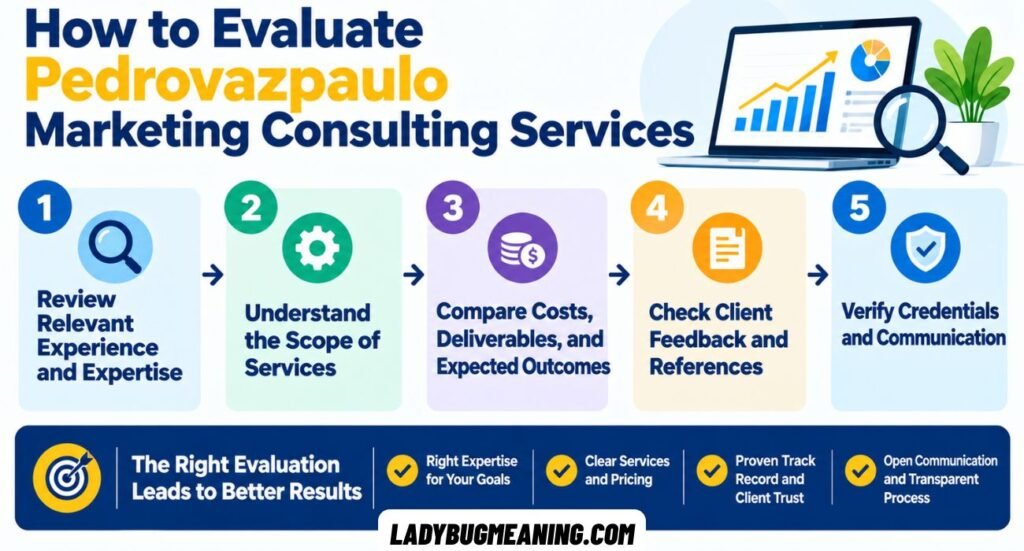
When researching pedrovazpaulo marketing consulting, readers should separate the general principles of marketing consulting from claims about a specific provider. A name or search phrase alone does not establish a consultant’s qualifications, track record, service offerings, or client results.
Before hiring any marketing consultant, review the available evidence and determine whether the service matches your business needs.
Review Relevant Experience and Expertise
Look for experience that relates directly to your industry, business model, or marketing challenge. A consultant who specializes in search engine optimization may be a good fit for a company seeking more organic traffic, while a business preparing a product launch may need broader positioning and campaign-planning expertise.
Review case studies carefully. Useful examples explain the original challenge, the work performed, the period covered, and the outcomes achieved. Ask whether results were measured against a clear baseline and whether other factors could have influenced them.
Client testimonials may offer additional context, but they should not replace evidence of relevant experience. When possible, seek references or independently verifiable examples.
Understand the Scope of Services
Marketing consulting can cover many different activities, so confirm exactly what a provider offers. Potential services include:
- Marketing audits and market research.
- Brand strategy and positioning.
- Search engine optimization and content strategy.
- Paid advertising and campaign planning.
- Website and landing-page conversion improvements.
- Email marketing and customer retention.
- Analytics setup and performance reporting.
Do not assume every provider offers all these services. Confirm the current service list directly and ask whether the engagement includes implementation, ongoing management, training, or strategy recommendations only.
Compare Costs, Deliverables, and Expected Outcomes
Consultants may charge hourly rates, fixed project fees, monthly retainers, or other agreed pricing structures. The appropriate arrangement depends on the project’s complexity, duration, level of support, and scope.
Compare proposals by examining the work included rather than focusing only on the price. A low-cost audit may be suitable for a business that needs an independent assessment, while a company seeking ongoing campaign management may require a broader engagement.
Ask how success will be measured, when progress will be reviewed, and which factors are outside the consultant’s control. Be cautious of guaranteed search rankings, assured revenue increases, or claims that a particular marketing strategy will work for every business.
For a provider-specific assessment, verify the current official website, service descriptions, professional background, contact details, contractual terms, and any independently supported client evidence. If those details are unavailable, treat them as unverified rather than assuming they are true.
Read more: The PedroVazPaulo Business Consultant
Steps to Becoming a Successful Marketing Consultant
Becoming a marketing consultant requires a combination of marketing knowledge, practical experience, communication skills, and business development. You do not necessarily need to follow one fixed career path, but you do need to demonstrate that you can identify marketing problems and develop useful solutions.
Whether you want to work independently, join a consulting firm, or build a specialized marketing agency, the following steps provide a practical starting point.
Education and Certifications
A degree in marketing, business administration, communications, or a related field can provide a strong foundation. However, formal education is not the only route into marketing consulting. Relevant work experience, practical projects, and demonstrated skills can also help establish credibility.
Aspiring consultants should understand market research, consumer behavior, brand positioning, digital marketing, marketing analytics, and business strategy. They should also learn how to interpret performance data and explain recommendations to decision-makers.
Professional certifications can help demonstrate knowledge of specific platforms and disciplines. For example, Google offers training and certifications through its Skillshop platform, while HubSpot Academy provides courses in areas such as inbound marketing, content marketing, and email marketing. Availability and certification requirements can change, so candidates should check the official training websites.
Certifications are most valuable when they support practical ability. Completing a course does not automatically make someone an experienced consultant. Businesses want professionals who can apply their knowledge to real problems, communicate clearly, and evaluate results honestly.
A useful learning plan combines structured education with hands-on practice. Create sample marketing plans, analyze public company websites, practice building reports, and learn how different channels contribute to customer acquisition and retention.
Building a Portfolio
A portfolio demonstrates what you can do and helps potential clients understand your approach. It should show how you identify problems, evaluate evidence, develop recommendations, and measure results.
If you have previous client work, include examples that you have permission to share. Explain the business challenge, your responsibilities, the strategy you recommended, and the results that can be verified. Protect confidential information and obtain approval before publishing client data.
Beginners without paid client experience can create clearly labeled sample projects. For example, you might conduct an SEO audit of a publicly available website, develop a content strategy for a hypothetical business, or create a marketing plan for a fictional product launch.
A useful portfolio project can include:
- Business challenge: Explain the problem the business needs to solve.
- Research: Describe the audience, competitors, and available evidence.
- Strategy: Outline the recommended marketing activities and explain why they fit the objective.
- Implementation plan: Identify priorities, responsibilities, and timelines.
- Measurement: Define the KPIs that would indicate progress.
Do not present simulated results as actual client achievements. If a project uses hypothetical data, state that clearly. Honest presentation builds more trust than impressive but unsupported claims.
Over time, update your portfolio with relevant projects and measurable outcomes. A smaller collection of well-explained examples is often more persuasive than a long list of services without supporting evidence.
Finding Clients
Finding clients is one of the most important challenges for independent marketing consultants. Strong technical skills are useful, but a consulting business also needs a clear offer, a defined audience, and a reliable process for generating opportunities.
Start by identifying the types of businesses you can serve effectively. You might specialize in SEO for local service businesses, content strategy for online publishers, or customer acquisition for small e-commerce brands. A focused offer makes it easier for potential clients to understand your expertise.
Networking can help you develop professional relationships and receive referrals. Attend relevant industry events, participate in professional communities, and connect with business owners who may benefit from your services. Educational content, such as practical articles, case studies, and useful marketing guides, can also demonstrate your knowledge.
Freelance marketplaces and professional networking platforms may provide additional opportunities. However, competition and pricing vary, so avoid depending on a single source of leads.
A practical client acquisition process includes the following steps:
- Define a specific service and the business problem it solves.
- Create a portfolio that demonstrates your approach.
- Develop a professional website or profile explaining your services.
- Identify suitable prospects through ethical research and networking.
- Offer a discovery conversation to understand their needs.
- Prepare a proposal with clear deliverables, timelines, fees, and success measures.
- Follow up professionally and maintain relationships with existing clients.
For example, a consultant who specializes in local SEO could offer an initial website and search visibility audit. The audit might identify missing location information, unclear service pages, technical issues, and opportunities to improve relevant content. The consultant could then propose a clearly scoped project based on the findings.
Avoid guaranteeing results that depend on factors outside your control. Build client relationships through realistic expectations, transparent reporting, and work that addresses genuine business needs.
Developing a Practical Marketing Consulting Process
A repeatable consulting process makes projects easier to manage and helps clients understand what they are paying for. Although every engagement has different requirements, a structured approach can reduce confusion and keep work aligned with business goals.
Step 1: Conduct a Discovery and Marketing Audit
Begin by understanding the client’s business objectives, target customers, existing marketing activities, and main challenges. Review available analytics, website content, advertising performance, sales processes, and customer feedback.
Ask what the business wants to achieve and how it currently measures success. A company seeking more qualified leads needs a different plan from one trying to improve repeat purchases.
Step 2: Identify the Main Opportunity
Use the audit to distinguish major problems from minor improvements. For example, low sales might result from poor traffic quality, confusing product information, weak conversion rates, or a difficult checkout process.
Each problem requires a different response. Increasing advertising spending will not necessarily help if the website fails to convert interested visitors into customers.
Step 3: Build a Prioritized Strategy
Recommend actions according to their potential business value, cost, effort, and risk. Establish what should happen first, what can wait, and which decisions depend on additional information.
A small business may need to fix conversion tracking and improve its service pages before investing in a new advertising campaign. A larger organization may need a coordinated strategy across multiple channels.
Step 4: Implement and Test Recommendations
Depending on the agreement, the consultant may execute the work, coordinate with internal teams, or provide guidance while the client handles implementation.
Use appropriate testing methods where possible. For instance, a business might compare two landing-page versions to evaluate which produces more qualified inquiries. Ensure the test is designed appropriately and avoid drawing strong conclusions from insufficient data.
Step 5: Measure Results and Refine the Plan
Compare performance against the baseline and agreed objectives. Identify what improved, what failed to meet expectations, and what the evidence suggests should happen next.
Marketing is an ongoing process rather than a one-time document. Regular reviews help businesses adapt to customer behavior, changing competition, and new opportunities.
Marketing Consulting vs. a Marketing Agency
Businesses often compare marketing consultants with agencies before deciding how to obtain professional support. Both can be useful, but their working arrangements and responsibilities may differ.
| Factor | Marketing consultant | Marketing agency |
|---|---|---|
| Main focus | Research, strategy, recommendations, and guidance | Often combines strategy with campaign execution |
| Team structure | May work independently or with a small team | Usually has a team with different specialties |
| Flexibility | Can provide focused, project-based advice | Can coordinate multiple services and campaigns |
| Implementation | Depends on the agreed scope | May provide ongoing execution and management |
| Best suited for | Businesses needing expertise, direction, or an independent review | Businesses needing coordinated support across several marketing activities |
These differences are general rather than universal. Some consultants manage campaigns directly, and some agencies concentrate mainly on strategy.
The right choice depends on your internal capabilities. If your team can implement recommendations but needs expert direction, a consultant may be sufficient. If you need help with strategy, content production, advertising management, and reporting, an agency may offer a more suitable arrangement.
Before deciding, identify the problem you want to solve, the work your team can handle, and the budget available for external support.
Measuring the Success of Marketing Consulting
Marketing consulting should be evaluated against agreed business objectives rather than the number of reports, meetings, or recommendations produced. A useful engagement helps the business make better decisions and understand whether its marketing activities contribute to meaningful outcomes.
Choose KPIs That Match Business Goals
The most appropriate performance indicators depend on the company’s objectives and sales process. A business focused on lead generation may track qualified inquiries and the percentage that become customers. An e-commerce business may focus on conversion rates, customer acquisition costs, and profit contribution.
Set targets that reflect the company’s starting position, available resources, and market conditions. Avoid selecting arbitrary benchmarks without considering the business’s industry and circumstances.
Monitor Progress Over Time
Marketing performance can fluctuate because of seasonality, competitive activity, changes in pricing, and other external factors. A single month’s results may not provide enough evidence to judge a strategy.
Use consistent reporting periods and document important changes. Where practical, controlled experiments can help identify the effect of individual changes more reliably than simple before-and-after comparisons.
Evaluate Commercial Impact
Marketing results should connect to business outcomes. More traffic may be useful, but the business also needs to understand whether that traffic generates relevant inquiries, sales, repeat customers, or other valuable actions.
A consultant should explain both successes and limitations. If the strategy improves lead quality but does not immediately increase revenue, the report should investigate the sales process and conversion timeline rather than claiming complete success.
See also: The Spiritual Meaning of Craving Cheese, Peanut Butter & Dairy
Common Marketing Consulting Mistakes to Avoid
Even knowledgeable consultants can make mistakes when they overlook the client’s business context or focus too heavily on individual marketing channels.
One common mistake is recommending tactics before diagnosing the problem. A company may ask for social media advertising when its main issue is an unclear offer or a poorly designed landing page. A proper assessment helps determine whether the requested solution addresses the underlying cause.
Another mistake is focusing on vanity metrics. Likes, impressions, and page views can offer useful context, but they do not automatically demonstrate business value. Consultants should connect these indicators to the outcomes the client actually wants.
Unrealistic promises can also damage a consulting relationship. Search rankings, sales, and advertising results depend on several factors, including competition, budget, product quality, customer demand, and implementation. A responsible consultant explains likely opportunities without guaranteeing uncertain outcomes.
Poor communication creates additional problems. If clients do not understand the scope of work, reporting schedule, or responsibilities, they may develop expectations that the consultant never agreed to meet. Clear contracts and regular updates help prevent these misunderstandings.
Finally, consultants should not treat every client the same way. A strategy that works for a large e-commerce company may be unsuitable for a small local service provider. Good consulting adapts recommendations to the client’s goals, resources, audience, and operational limitations.
Frequently Asked Questions
What is pedrovazpaulo marketing consulting?
Pedrovazpaulo marketing consulting is a search phrase used to explore marketing consulting associated with the Pedrovazpaulo name. Verify the provider’s current services, qualifications, and documented results through reliable sources before relying on specific claims.
What does a marketing consultant do?
A marketing consultant evaluates a business’s marketing activities, researches its audience and competitors, and recommends strategies to improve performance. Depending on the agreement, the consultant may also help implement campaigns and measure results.
How much does a marketing consultant cost?
Marketing consulting fees vary according to experience, specialization, project complexity, and service scope. Consultants may charge hourly rates, fixed project fees, or monthly retainers. Request a detailed proposal before comparing prices.
Is marketing consulting worth it for small businesses?
It can be valuable when a business needs specialized expertise, a clear marketing plan, or help identifying wasted spending. The benefits depend on whether the recommendations address real business problems and whether the company can implement them.
What qualifications do you need to become a marketing consultant?
There is no single universal qualification for all marketing consulting roles. Relevant education, practical marketing experience, analytical ability, communication skills, and a portfolio can help establish credibility. Specialized certifications may also support particular areas of expertise.
How do marketing consultants find clients?
Consultants commonly use professional networking, referrals, industry communities, online portfolios, educational content, and freelance platforms. A clearly defined service and credible examples of work help potential clients evaluate their suitability.
What is the difference between marketing consulting and digital marketing?
Marketing consulting focuses on analyzing business needs and developing marketing strategies, which may include both digital and traditional channels. Digital marketing focuses on online channels such as search, websites, email, social media, and online advertising. The two areas often overlap.
How can you measure marketing consulting results?
Measure results against agreed objectives using relevant KPIs, such as qualified leads, conversion rates, customer acquisition costs, revenue, or retention. Establish a baseline and consider external factors before attributing changes entirely to the consultant.
Conclusion
Marketing consulting helps businesses replace guesswork with informed decisions, clearer priorities, and measurable objectives. Effective consultants combine analytical skills, communication, business knowledge, and practical marketing expertise to develop strategies that fit a company’s goals and resources. They also establish realistic expectations, protect client information, and evaluate results transparently.
When researching pedrovazpaulo marketing consulting, focus on verified information about the provider, relevant experience, service scope, and measurable outcomes. Whether you want to hire a consultant or become one, the most important principles remain the same: understand the problem, build a practical strategy, measure progress, and improve decisions using reliable evidence.