

Pedro Paulo Business Consultant: Leadership & Strategy Development
Business growth requires more than a good product or an ambitious founder. Companies need a clear strategy, capable leaders, reliable data, and a practical plan for turning ideas into results. A Pedro Paulo business consultant is associated with business strategy, operational improvement, leadership development, and planning support through the PedroVazPaulo consulting practice.
For business owners and executives, the main challenge is often deciding what to prioritize. A company may have strong sales but weak profit margins, talented employees but unclear responsibilities, or ambitious growth targets without enough resources to achieve them. A structured consulting approach can help identify these gaps and connect business goals with practical actions.
This guide explains modern business strategy, leadership development, strategic planning, data-driven decisions, and performance measurement. It also outlines how to evaluate a business consultant and determine whether consulting support fits your organization’s needs.
Read also: Pedro Paulo executive coaching
Understanding Modern Business Strategy
Modern business strategy is the process of deciding where a company wants to compete, how it will create value, and which resources it will use to achieve its objectives. It connects market opportunities with organizational strengths, financial realities, and measurable business goals.
The PedroVazPaulo business consulting website describes an approach involving business assessment, tailored strategy development, implementation, and performance review.
PThese activities are relevant to companies that need more than general advice and want a clear path from planning to execution.
A strong strategy should answer three fundamental questions: What does the business want to achieve? What advantages can help it succeed? What actions must it take to reach its goals?
For example, a small software company may want to increase recurring revenue. Rather than immediately hiring more salespeople, leadership could examine customer retention, product adoption, pricing, and the reasons existing customers leave. This analysis may reveal that improving customer experience offers a more practical opportunity than expanding the sales team.
Key Elements of Successful Strategy
A successful business strategy connects several essential elements. Each one helps decision-makers understand the company’s position and choose realistic priorities.
Clear vision and objectives: A company needs a defined direction and specific goals. Objectives should explain what success looks like and when the organization expects to achieve it.
Market and customer understanding: Businesses must understand their target customers, competitors, industry changes, and unmet market needs. This information helps them identify opportunities that fit their capabilities.
Competitive advantage: A company needs a credible reason for customers to choose its products or services. This advantage may come from product quality, specialized expertise, customer service, convenience, pricing, or a distinctive business model.
Resource alignment: Strategy must reflect available money, people, technology, and time. An attractive plan may fail if the organization lacks the capacity to execute it.
Execution and accountability: Every major objective needs an owner, a timeline, appropriate resources, and a way to measure progress.
Consider a retail business planning to open a second location. Its strategy should address local demand, expected operating costs, staffing requirements, inventory, competition, and cash flow. Expanding simply because the first location performs well may create avoidable financial pressure.
Common Strategy Pitfalls to Avoid
Many business strategies fail during execution rather than during the planning stage. Leaders may understand what they want to achieve but underestimate the work required to make it happen.
One common mistake is setting too many priorities. When every department launches a separate initiative, employees can become overwhelmed and important projects may compete for the same resources. Limiting the number of major priorities helps leadership focus attention and measure results more clearly.
Another problem is relying on assumptions instead of evidence. A business owner might believe customers want a new service without checking demand, willingness to pay, or the cost of delivering it. Small experiments and customer research can test these assumptions before the company commits significant resources.
Poor communication also creates strategic problems. If sales teams focus on revenue while operations focus only on reducing costs, the departments may make decisions that conflict with wider business objectives.
Organizations can reduce these risks by assigning responsibility, communicating priorities, reviewing performance regularly, and adjusting plans when the evidence changes.
Role of Data in Strategy Development
Business data helps leaders understand what is happening, why it may be happening, and which actions deserve attention. Useful information can come from financial statements, customer surveys, sales records, website analytics, inventory systems, employee feedback, and operational reports.
However, collecting data is not the same as using it effectively. The information must be accurate, relevant, timely, and connected to a specific business question.
For example, an online store may notice that website traffic has increased while sales remain unchanged. Looking only at traffic could create the impression that marketing is working well. Examining conversion rates, checkout abandonment, average order value, and customer acquisition costs may reveal that visitors are not finding the products or prices they expect.
A practical data-driven strategy follows four steps:
- Identify the business question that needs an answer.
- Select reliable data that can help explain the problem.
- Compare the evidence with business objectives and constraints.
- Test an action and measure whether the outcome improves.
Data should support professional judgment, not replace it. Leaders must consider context, data quality, uncertainty, and the possibility that an apparent relationship does not establish cause and effect.
Leadership Development Framework
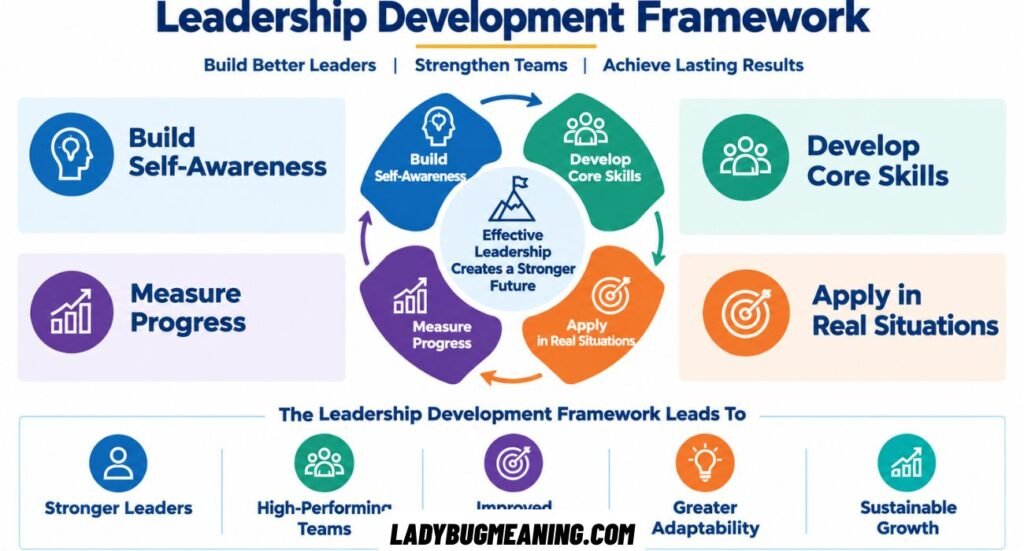
Business strategy depends on the people responsible for carrying it out. Even a well-designed plan can struggle when leaders communicate poorly, avoid difficult decisions, or fail to establish accountability.
A leadership development framework identifies the skills and behaviors that managers need to guide teams toward shared objectives. The PedroVazPaulo website includes executive coaching and leadership development among its described services.
The practical goal is to connect individual leadership growth with organizational needs. A business owner preparing for expansion, for example, may need to delegate more responsibilities, strengthen middle management, and spend less time solving routine operational problems.
Core Leadership Competencies
Effective leaders combine people skills with sound business judgment. The most relevant competencies vary by role, industry, and organizational maturity, but several capabilities are widely useful.
Communication: Leaders must explain priorities, clarify expectations, listen to employees, and provide constructive feedback.
Strategic thinking: Managers need to understand how individual decisions affect wider business goals, resources, and long-term performance.
Emotional intelligence: Recognizing emotional reactions and considering other people’s perspectives can help leaders manage conflict and respond more thoughtfully under pressure.
Delegation: Effective managers assign responsibility clearly, give employees suitable authority, and monitor results without controlling every detail.
Adaptability: Leaders must respond to new evidence, customer needs, competitive changes, and unexpected operational problems.
Accountability: Strong leaders accept responsibility for decisions, establish clear expectations, and address performance gaps fairly.
These competencies can be developed through feedback, coaching, training, deliberate practice, and reflection. For example, a manager who struggles to delegate might begin by transferring ownership of one recurring task, defining the expected outcome, and reviewing the results after an agreed period.
Decision-Making Process Improvement
Business decisions often involve incomplete information, competing priorities, and uncertainty. A consistent decision-making process helps leaders reduce avoidable errors without creating unnecessary delays.
A useful framework begins by defining the problem precisely. Leaders should distinguish the underlying issue from its visible symptoms. Falling profits, for instance, may result from rising costs, declining prices, poor customer retention, or an unprofitable product mix.
Next, decision-makers identify realistic options and assess each one against agreed criteria. Those criteria may include expected financial impact, implementation time, operational risk, customer experience, and available resources.
The final stages involve choosing an option, assigning responsibility, and reviewing the outcome.
A practical decision-making framework
- Define the problem. State the issue clearly and identify the outcome that needs to change.
- Gather relevant evidence. Review financial, operational, customer, and market information.
- Compare alternatives. Assess likely benefits, costs, risks, and trade-offs.
- Make and communicate the decision. Explain the reasoning and assign clear responsibilities.
- Measure the result. Compare actual performance with expectations and adjust when necessary.
For example, a company experiencing late deliveries could respond by hiring more staff, changing suppliers, improving scheduling, or redesigning its workflow. A structured analysis helps leaders determine which option addresses the underlying cause instead of simply treating the symptom.
Read more: Why Top CEOs Choose Pedro Paulo Executive Coaching?
Strategic Planning Process
Strategic planning translates a company’s long-term direction into specific priorities, projects, budgets, and responsibilities. It gives leadership and employees a shared understanding of what matters most and how the organization intends to make progress.
The PedroVazPaulo strategy consulting page describes activities such as strategic discovery, market and competitor analysis, roadmap development, execution alignment, and performance review.
Plan, Execute, Grow Businesses considering consulting support should confirm which activities are included in the particular engagement.
Market Analysis Techniques
Market analysis helps organizations evaluate customer demand, competitive pressure, industry conditions, and opportunities for differentiation. The appropriate method depends on the decision the business needs to make.
Several established techniques can help:
- SWOT analysis: Identifies internal strengths and weaknesses alongside external opportunities and threats.
- PESTLE analysis: Examines political, economic, social, technological, legal, and environmental factors affecting the business.
- Competitor analysis: Compares products, pricing, positioning, customer experience, and market approaches.
- Customer research: Uses interviews, surveys, support records, and buying behavior to understand customer needs.
- Market segmentation: Groups customers according to relevant characteristics, needs, or behaviors to improve targeting.
These methods work best when they answer specific questions rather than becoming paperwork exercises.
A local service company considering expansion into a neighboring city, for example, could research population characteristics, local competitors, service demand, travel costs, and customer acquisition channels. The findings would help determine whether the opportunity justifies the investment.
Market analysis should also recognize uncertainty. Competitor pricing can change, survey respondents may not represent the wider market, and past demand does not guarantee future sales. Leaders should identify important assumptions and test them when possible.
Goal Setting and Alignment
Strategic goals should connect the company’s overall direction with departmental priorities and individual responsibilities. Without this connection, employees may work hard on activities that do little to support the organization’s most important objectives.
A useful approach is to establish a small number of high-level objectives and translate them into measurable targets. Some organizations use the SMART framework, which encourages goals to be specific, measurable, achievable, relevant, and time-bound.
For example, a company might set a broad objective to improve customer retention. The customer success team could then monitor renewal rates, while the product team investigates recurring usability problems and the support team tracks response times.
The teams contribute to the same objective through different responsibilities. Regular planning meetings help leadership identify conflicts, resolve dependencies, and ensure that targets remain realistic.
Goals should also be reviewed when circumstances change. A target that was sensible before a major supplier disruption may need adjustment after the business reassesses its costs and capacity.
Resource Allocation Strategies
Resource allocation determines how an organization distributes its budget, people, technology, and time among competing priorities. It is a central part of strategic planning because businesses rarely have unlimited resources.
A practical allocation process starts by estimating the cost and expected value of each major initiative. Leaders should consider implementation expenses, ongoing operating costs, financial risks, staffing requirements, and the time needed to see results.
They can then compare initiatives according to strategic importance, feasibility, urgency, and potential impact.
For example, a growing company might need to choose between upgrading its customer relationship management system, launching a new product, and hiring additional sales staff. The right decision depends on the company’s current bottlenecks, financial position, and growth objectives rather than on which project sounds most exciting.
Resource allocation should remain flexible enough to accommodate unexpected needs. However, changes should be documented and evaluated carefully so that urgent requests do not repeatedly displace important long-term work.
A business consultant can help leadership examine these trade-offs, identify operational constraints, and build a realistic implementation roadmap. The value of that support depends on the quality of the analysis and how well the recommendations fit the company’s circumstances.
Measuring Strategic Success
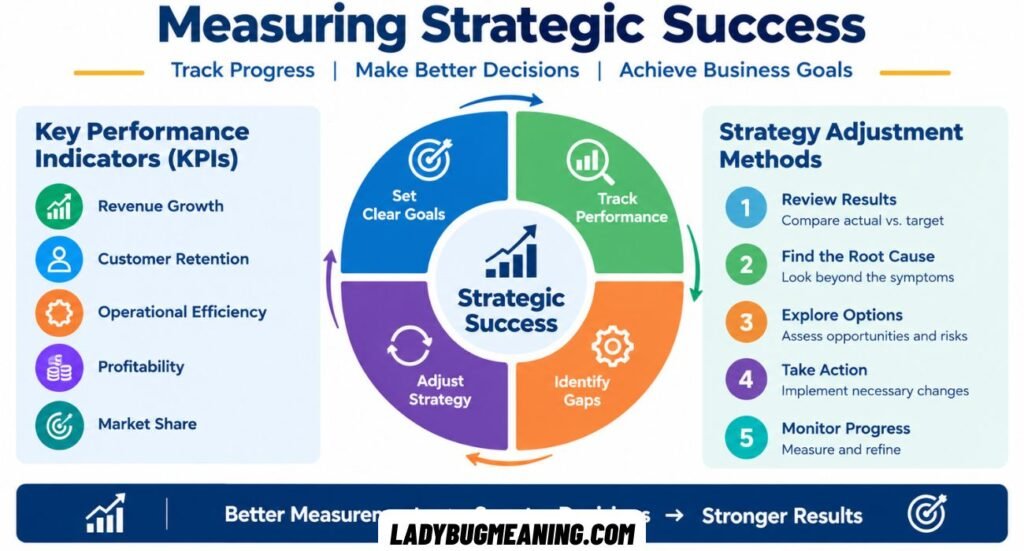
A business strategy needs a reliable way to determine whether it is working. Without performance measurement, leaders may continue investing in activities that consume resources without delivering the intended results.
The best measurement system connects business objectives with a small set of meaningful indicators. These indicators should help managers understand progress, identify problems, and decide when to change course.
Key Performance Indicators
Key performance indicators (KPIs) are measurable values used to evaluate progress toward important business objectives. A useful KPI measures something relevant to the decision being made, rather than simply producing a number for a dashboard.
Different business goals require different indicators.
| Business objective | Example KPIs | What they help assess |
|---|---|---|
| Increase profitable growth | Revenue growth, gross margin, operating profit | Whether growth is financially sustainable |
| Improve customer retention | Customer retention rate, repeat purchase rate, churn rate | Whether customers continue buying or using the service |
| Improve marketing performance | Conversion rate, customer acquisition cost, qualified leads | Whether marketing attracts valuable customers efficiently |
| Increase operational efficiency | Cost per unit, cycle time, error rate | Whether processes use resources effectively |
| Strengthen team performance | Employee turnover, goal completion, relevant engagement measures | Whether teams are stable and meeting agreed objectives |
| Improve cash management | Operating cash flow, receivables days, cash runway | Whether the business can meet financial obligations |
KPIs need context to be useful. A rising revenue figure may look positive, but if expenses increase faster than sales, profitability may decline. Likewise, reducing costs could damage customer service if the company cuts resources that are essential to delivering value.
Each KPI should have a clear definition, a data source, a reporting frequency, and an assigned owner. Leaders should also establish a baseline and a realistic target before evaluating performance.
Strategy Adjustment Methods
A strategy should provide direction without preventing the organization from responding to new evidence. Regular reviews help leaders identify what is working, what is falling behind, and what needs to change.
One useful method is a monthly or quarterly strategy review. During this review, managers compare actual results with targets, investigate significant differences, and decide whether corrective action is needed.
A practical review should consider three questions:
- What changed? Identify meaningful differences between expected and actual performance.
- Why did it change? Investigate underlying causes instead of assuming that the first explanation is correct.
- What should happen next? Decide whether to continue, improve, pause, or replace the current initiative.
For example, a company may launch a new service with an initial sales target. If sales remain below expectations, the team should examine awareness, pricing, customer demand, sales conversations, and delivery constraints before abandoning the idea.
Some strategies need minor adjustments, while others require a major change in direction. The decision should depend on evidence, the cost of continuing, available alternatives, and the time remaining to achieve the objective.
How a Business Consultant Can Support Implementation
Business consulting is most useful when analysis leads to clear decisions and practical action. A consultant may provide an external perspective, help identify organizational bottlenecks, evaluate alternatives, and support leadership as it develops a plan.
The PedroVazPaulo business consulting website describes a process involving strategic discovery, business analysis, tailored planning, execution support, and performance tracking.
These descriptions provide a starting point for understanding the practice, but prospective clients should confirm the actual scope and deliverables of any proposed engagement.
From Business Diagnosis to Action Plan
A consulting engagement can begin with a review of the company’s goals, financial position, market conditions, processes, and leadership challenges. The purpose is to identify the issues that matter most and distinguish root causes from symptoms.
The consultant and business leadership can then agree on priorities, define the desired outcomes, and develop an implementation plan. That plan should specify milestones, responsibilities, resources, and measures of success.
For instance, a business experiencing repeated project delays may discover that the primary problem is not employee productivity but unclear approval responsibilities. Clarifying decision rights and simplifying the approval process may be more useful than asking staff to work longer hours.
What to Look for in a Business Consultant
Choosing a consultant requires more than reviewing a service list or promotional claims. The provider should understand the business problem, explain the proposed approach, and demonstrate how recommendations will be evaluated.
Before hiring a consultant, consider the following:
- Relevant experience: Ask about comparable business challenges and the consultant’s role in addressing them.
- Clear scope: Request a written description of the work, deliverables, exclusions, and timeline.
- Practical recommendations: Confirm that the proposed work will result in actionable decisions rather than only general observations.
- Transparent fees: Understand the pricing structure, payment terms, and potential additional costs.
- Measurable objectives: Agree on how progress will be reviewed and what the consultant can reasonably influence.
- Confidentiality: Clarify how financial records, customer information, employee data, and business plans will be protected.
- Independent verification: Check references, credentials, and relevant professional claims where appropriate.
A credible consultant should be willing to discuss limitations, risks, and alternative approaches. No consultant can guarantee business growth because market conditions, competition, execution, and other external factors influence results.
See also: Color Pink Spiritual Meaning
How to Evaluate the Return on Consulting
Businesses should consider consulting costs alongside the value of the outcomes they hope to achieve. That value may include increased profit, reduced waste, improved cash flow, better project delivery, or stronger management capability.
Where a financial return can be measured, a basic calculation is:
\[ \text{ROI}=\frac{\text{Net benefit}}{\text{Total investment}}\times100\% \]
Here, net benefit means the financial benefit attributable to the initiative after subtracting its relevant costs, while total investment includes the consulting fee and other applicable implementation expenses. The calculation is meaningful only when the underlying estimates are reasonable and the benefits can be attributed appropriately.
Not every benefit can be reduced to money. Better decision-making, stronger leadership, and clearer organizational responsibilities may also matter, although they can be harder to quantify.
For a fair assessment, establish a baseline before the engagement, record additional costs, agree on the evaluation period, and compare results with realistic expectations. This creates a stronger basis for deciding whether the engagement delivered value.
FAQs
What are the key elements of a successful business strategy?
A successful business strategy includes clear objectives, market research, competitive positioning, resource allocation, execution planning, and performance measurement. These elements help businesses prioritize opportunities and connect daily operations with long-term goals.
How does data play a role in modern strategy development?
Data helps businesses understand customer behavior, market conditions, operational efficiency, and financial performance. Leaders can use reliable data to compare options, test assumptions, identify risks, and measure whether strategic decisions produce the intended results.
What are the core leadership competencies emphasized in leadership development?
Important leadership competencies include communication, strategic thinking, emotional intelligence, delegation, adaptability, and accountability. Developing these skills helps managers guide teams, resolve conflicts, make informed decisions, and align employee efforts with business objectives.
How can organizations improve their decision-making process?
Organizations can improve decisions by defining problems clearly, gathering relevant evidence, comparing alternatives, evaluating risks, and assigning responsibility for implementation. Regular reviews help leaders determine whether decisions are producing the expected outcomes.
What are some effective methods for measuring strategic success?
Businesses can measure strategic success using key performance indicators such as revenue growth, profit margins, customer retention, conversion rates, and operational efficiency. Each indicator should connect to a specific objective and have a clear baseline, target, and review schedule.
What services does Pedro Paulo business consultant provide?
The PedroVazPaulo website describes business consulting, strategy consulting, operational improvement, IT consulting, and executive coaching. Available services and deliverables should be confirmed directly with the provider before entering into an agreement.
How can a business consultant help a growing company?
A business consultant can help a growing company assess its current position, identify operational problems, evaluate market opportunities, and develop a practical growth plan. The consultant may also help establish performance measures and clarify responsibilities for implementation.
How should a business choose the right consultant?
A business should evaluate a consultant’s relevant experience, problem-solving approach, proposed deliverables, fees, confidentiality practices, and ability to measure progress. A written agreement with clear responsibilities and realistic expectations helps both parties understand the engagement.
Conclusion
Business success depends on more than ambition. It requires a clear strategy, capable leadership, reliable information, and disciplined execution. By combining market analysis, leadership development, resource planning, and performance measurement, organizations can make better decisions and respond more effectively to changing business conditions.
A Pedro Paulo business consultant is one option to research when seeking support with business strategy and leadership development. Review the provider’s current services, verify relevant qualifications, and establish measurable objectives before committing. The ultimate goal is to build a practical strategy that supports sustainable growth and helps your organization make better decisions over time.


