
Few insects get a welcome like the ladybug. It lands on a sleeve and people smile instead of brushing it away; it turns up on a windowsill and the first thought is not “pest” but “sign.” If you have come here asking about ladybug meaning, you are asking what generations of farmers, gardeners and grandmothers asked before you — and their answer was unusually consistent for a piece of folklore.
The short version is that a ladybug is read as good news in miniature: luck, protection, love and a fresh start, carried by an insect that really does protect the plants it walks on. But the meaning changes with the moment. A ladybug on your hand is not read the same way as one found dead by the window, and a black ladybug is not telling you what a red one is.
This page is the complete map. It gives you the quick answer first, then the real beetle underneath the folklore — because the two hold each other up — then every encounter, color and spot count, with the old traditions labeled as traditions and the modern readings labeled as modern.
Ladybug Meaning: The Quick Answer
Quick Answer: Ladybug meaning is good fortune, protection, love and renewal. In European folklore a ladybug landing on you is a stroke of luck and a cue to make a wish; ladybugs in the house are read as protection over the home, and the beetle’s old name — “Our Lady’s bird” — ties its red shell and seven spots to the Virgin Mary. Underneath the folklore sits a real garden guardian: a beetle that spends its life eating aphids.
Everything below is the detail behind that answer — where the tradition ends and the beetle begins.
What a Ladybug Actually Is
Before the meanings, meet the insect — because almost everything people believe about ladybugs grows out of something the animal actually does.
A ladybug is not a bug at all. True bugs are a different order of insects; the ladybug is a beetle, in the family Coccinellidae, which Encyclopaedia Britannica puts at roughly 5,000 species spread over every continent except Antarctica. Most are small and dome-shaped — Britannica gives a typical length of 8 to 10 millimetres — with short legs and bright wing cases marked in black. In North America it is called a ladybug, in Britain a ladybird, and scientists say lady beetle.
The one in the storybooks is the seven-spot ladybird, Coccinella septempunctata: scarlet wing cases, three black spots on each case and a seventh where the two cases meet. Its red is not decoration. The bright pattern is warning coloration, and a disturbed ladybird backs it up by squeezing a bitter yellow fluid from its leg joints — a defense called reflex bleeding, which is the faint yellow trace one sometimes leaves on your skin. A bird that mouths a ladybird once tends to leave the pattern alone for life.
What the beetle does with that protection is eat. Ladybugs hunt aphids, scale insects and mites, and the appetite is measured, not mythical: Britannica records a single convergent ladybug larva eating 300 aphids in two weeks, and an adult female devouring several thousand across her roughly three-month life. The whole life cycle — egg, spiky grey larva, pupa, adult — takes about four weeks, and the female lays her eggs on leaves right beside aphid colonies so the larvae hatch inside their food supply. This is the fact the entire luck tradition stands on: a field full of ladybirds was a field whose pests were being eaten.
Three more facts matter for the meanings below. First, spots are fixed by species, not by age — a seven-spot is born with seven, some species have two or twenty-two, and some have none at all; a newly emerged adult is soft and pale for its first hours, and its colors and spots set as the shell hardens. Second, ladybirds overwinter as adults, often gathered in large groups in sheltered places — which is why they turn up indoors in autumn. Third, many of those indoor gatherings are the multicolored Asian lady beetle, Harmonia axyridis, a true lady beetle recognizable by the black M-shaped mark behind its head; University of Minnesota Extension notes that these beetles cluster around buildings in fall looking for winter shelter and do not breed indoors.
Ladybug Spiritual Meaning
Spiritually, the ladybug is read as a small, kind messenger: a sign that help is near, that what you are tending is protected, and that a hard season is turning. The core themes the spiritual tradition returns to are luck arriving quietly, protection that does not need to shout, love handled gently, and renewal — the beetle’s own journey from a spiky, earthbound larva to a winged adult makes it the tradition’s favorite picture of a self mid-change.
That is the summary, and it is deliberately a summary. The full spiritual treatment — all fourteen readings the guides give a sighting, each one labeled by how old the idea actually is, from the centuries-deep Marian dedication down to the readings invented within living memory — is kept complete in one place: our sister site’s guide to ladybug spiritual meaning. This page will not repeat it in thinner form. What follows is everything around it.
What a Ladybug Symbolizes: The Five Core Themes
Luck and Good Fortune
The founding meaning, and the only one that began as an observation. Ladybirds ate the aphids eating the crop, the harvest improved, and the beetle was credited. From that working fact grew the customs: never brush a ladybug off, make a wish as it flies away, count its spots for the lucky months ahead. In Turkey the insect is still called uğur böceği — “good luck bug.”
Love and Gentle Affection
Love enters the tradition through the matchmaking customs. In Europe a ladybug let go from a young woman’s hand was said to fly toward her future partner, and a French custom counted the moments until the beetle flew as the years until a marriage. Read today, the ladybug in love means affection that arrives without force — timing, tenderness, and care given to a bond that is already growing.
Protection
A creature this small, this slow and this apparently defenseless, which nevertheless thrives on every continent, invites a guardian reading — and the beetle earns it twice over: warning colors and bitter blood for itself, and a lifetime of pest control for the garden it walks on. In the tradition, a ladybug near your door, your plants or your person is read as a small guard posted there: what you value is being looked after.
Transformation and New Beginnings
Egg, larva, pupa, adult — nothing in the sequence resembles the stage before it, and the finished beetle even spends its first hours pale and unmarked before its colors arrive. Symbolism writers lean on that arc hard, and it bears the weight: the ladybug is the standing picture of a change that looks like nothing while it is happening and like renewal when it is done.
Joy, Gratitude and Small Blessings
The gentlest theme, and the one that asks least of you. People smile when a ladybug lands on them — the tradition treats that involuntary lift as part of the message. A ladybug is read as a reminder that help and happiness often arrive at beetle scale: small, unannounced, and easy to miss if you are only watching for big things.
Ladybug Encounters and What They Mean
Context is the tradition’s own rule: where and how you meet the beetle changes the reading. Here is the whole encounter map, with the plain explanation kept beside the folklore — because for most of these, the beetle has a reason of its own.
| Encounter | What tradition says | What is actually happening |
|---|---|---|
| A ladybug lands on you | A blessing that found you; make a wish before it flies | The beetle is exploring or resting; the wish custom is centuries-old European folklore |
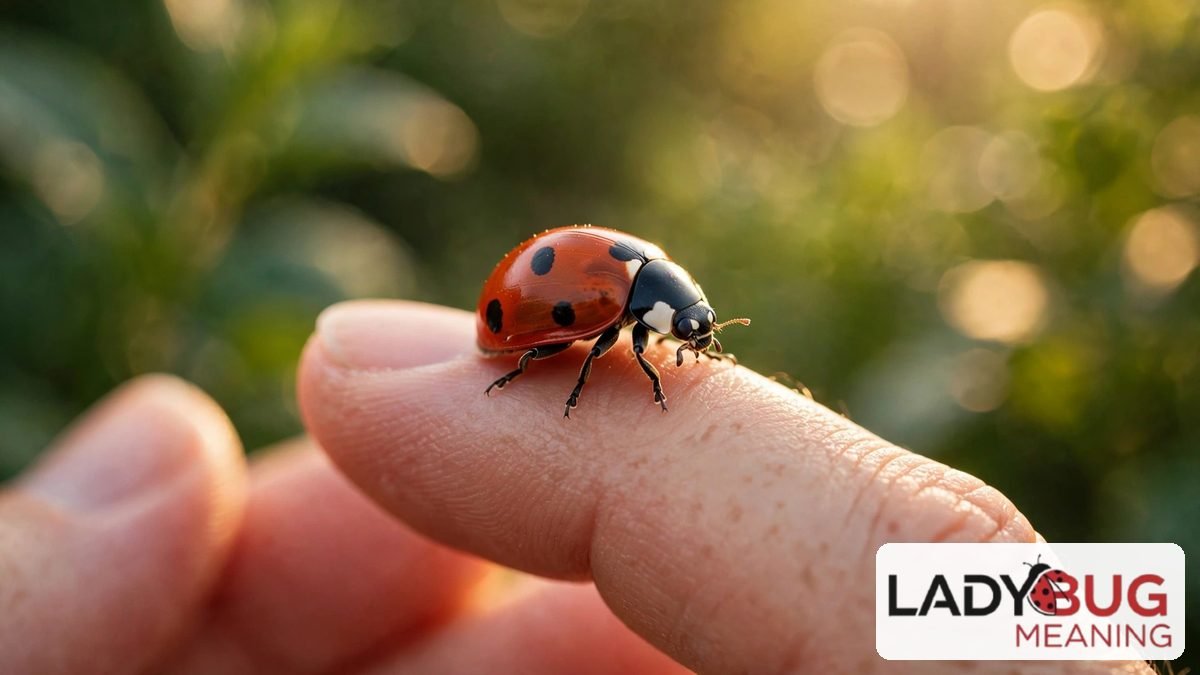
| A ladybug on your hand | Favor on what you are building and reaching for | Hands are warm, still landing pads — the reading is modern, the welcome is old |
| One ladybug in the house | Protection over the home; a welcome guest | A beetle that has found shelter, often after wandering in through a window |
| A cluster of ladybugs indoors in autumn | Your home chosen as a safe place; a season of shelter | Overwintering behavior — very often Asian lady beetles gathering to sleep through winter |
| Seeing ladybugs again and again | A season of noticing; help is around you | Ladybirds are abundant in aphid season, so repeat sightings are common |
| Finding a dead ladybug | A cycle complete; release what has finished its work — not a curse | Indoor beetles often die at winter’s end, spent after sheltering; windowsills are the usual place |
| A swarm or large gathering | Abundance; a blessing at scale | A seasonal aggregation — some species gather in the thousands or millions to overwinter |
| A ladybug on your car or window | Good fortune travelling with you; a sign noticed on the move | Beetles land on warm, bright surfaces — cars and glass qualify |
When a Ladybug Lands on You
This is the classic encounter, and the one with the deepest roots. European custom held that a ladybird settling on a person brought luck with it, that it should never be brushed away — brushing discarded the gift — and that a wish made while it stayed would be carried off when it flew. It works the same way people read bees flying around or landing on you: the creature chose you, briefly, out of the whole garden. A dedicated guide to the landing encounter, including the readings by body part, is planned for this site.
Ladybugs in the House
One beetle on a windowsill is a visitor; dozens clustered in a window frame in October are a season. The autumn gatherings are usually Asian lady beetles finding a dry crevice to sleep through winter, and a beetle that reappears on a warm January day has not arrived from nowhere: it came in last fall and woke in the warmth. The folklore reading layered over that fact is refuge — a home chosen as safe. Both can be true at once. They do not breed indoors, and the kind response is to let them be or move them gently to a sheltered spot outside.
Finding a Dead Ladybug
People find this one unsettling, but the tradition is kinder than the feeling. A dead ladybug is read as completion, not punishment: a protective season ending, a blessing that has done its work, something ready to be released. The plain facts support the gentleness — a beetle found dead on a late-winter windowsill is usually one that sheltered indoors and reached the end of its natural span. It is a closing, not a warning.
Ladybug Colors and Their Meanings
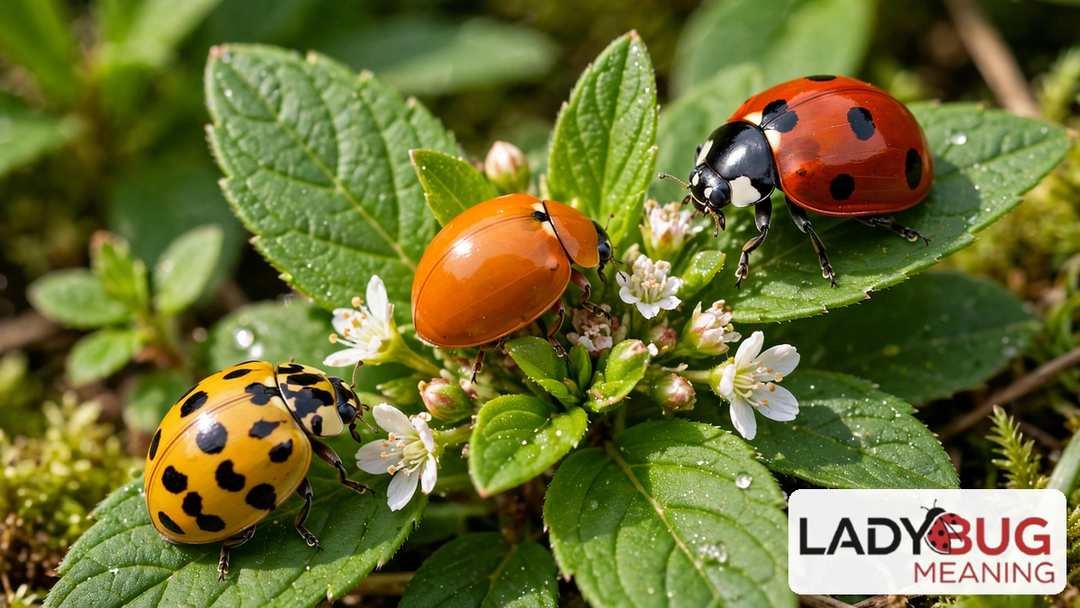
Two things are true at once: a ladybug’s color mostly tells you which species you saw, and modern spiritual readers have given each color a meaning of its own. The meanings in this table are the modern readings — labeled as such, not ancient tradition — and the beetle column keeps the identification honest. The deep, species-by-species guides live on our sister site, linked from each row.
| Color | Often the real beetle | What it is read to mean | Deep guide |
|---|---|---|---|
| Red | The seven-spot ladybird and other classic red species | Vitality, love and protection — the luck color itself | Red ladybug meaning |
| Orange | Frequently the Asian lady beetle; Britain also has a true orange ladybird with white spots | Creative movement, encouragement, effort turning into results | Full guide coming on this site |
| Yellow | The 22-spot and 14-spot ladybirds — or a cucumber beetle impostor | Optimism, clarity and new beginnings | Yellow ladybug meaning |
| Green | Almost never a ladybird — usually a cucumber beetle; the one genuine green is a metallic Australian species | Growth, healing and renewal | Green ladybug meaning |
| Brown | Tree species such as the larch and cream-spot ladybirds | Grounding, patience and quiet stability | Brown ladybug meaning |
| Black | Black forms of the Asian lady beetle; the twice-stabbed lady beetle is shiny black with two red spots | Inward steadiness, boundaries, strength held quietly | Full guide coming on this site |
| White | The fifteen-spotted and ashy gray lady beetles — or any ladybird in its first pale hours | Purity, clarity and a fresh start | White ladybug meaning |
| Blue | The steelblue ladybird of Australia — the family’s one true blue | Calm, truth and finding your voice | Blue ladybug meaning |
| Pink | The pink spotted lady beetle of North America, pink-red with twelve spots | Tenderness, affection and gentle good fortune | — |
What the Spots on a Ladybug Mean
Spots are where folklore and biology meet, so it helps to hold them apart. The folklore first. The seven spots of the seven-spot ladybird were read in Christian Europe as the Virgin Mary’s seven joys and seven sorrows — a devotional association with one beloved species, recorded by the Royal Entomological Society among others. A second old custom counted a landing ladybug’s spots as the number of lucky months ahead. A third, recorded in France, counted time rather than spots: the years recited aloud until the beetle flew were said to tell when a woman would marry.
Now the biology, which is just as interesting: a ladybug’s spot count is set by its species and does not change with age — the idea that spots count a ladybug’s years is a myth. Some species carry more than twenty spots, some carry two, and some carry none at all; and every ladybird spends its first adult hours spotless, soft and pale while its shell hardens and the pattern prints through. The short readings, then:
- No spots: read as a fresh start — a blessing without conditions, or a self whose colors are still setting. Often literally a young beetle, or a spotless species.
- Two spots: usually the two-spot ladybird. Read as balance and partnership — a pair, in step.
- Seven spots: the classic. The Marian number — joys and sorrows carried together, and the beetle at the heart of the whole tradition.
- Many spots (14, 22 and beyond): abundance in the modern reading. In the field, a high count usually names a mildew-eating species like the 22-spot — a gardener of a different kind.
Ladybug Dreams
Dreaming of a ladybug is read, across the dream tradition, as good things being tended out of sight — luck forming, protection felt during a vulnerable stretch, a small joy on its way. As with waking encounters, the scenario carries the meaning:
- A ladybug lands on you in a dream: a blessing you are ready to accept.
- Many ladybugs: support — your circle is bigger than you think.
- A dead ladybug in a dream: a chapter closing cleanly, not a loss to fear.
- A ladybug flying away: something finished, released, or a wish sent out.
- A ladybug on a plant or in a garden: quiet work protecting something you care about.
The honest note: dream readings are the softest layer of the tradition — modern symbolism, not documented custom — and the feeling the dream left behind is usually a better guide than any list. A full ladybug dream guide is planned for this site.
Ladybugs in the Bible and the “Our Lady’s Beetle” Tradition
Plainly, first: no verse in the Bible mentions the ladybug. The King James text names a beetle exactly once — in the Leviticus 11:22 list of insects that may be eaten — and it is not this one. Anyone who tells you ladybugs carry a biblical meaning, verse and chapter, is selling you something the text does not contain.
The real connection is almost as old and much better documented: it is a naming tradition, not a scripture. In the Middle Ages the beetle was dedicated to the Virgin Mary and called the “beetle of Our Lady” — Britannica records the name’s origin exactly there — because Mary was painted in a red cloak and the common species’ seven spots were matched to her seven joys and seven sorrows. The dedication survives across Europe’s languages: German keeps Marienkäfer, “Mary’s beetle,” and an old French name is bête à bon Dieu, “the good Lord’s creature.”
The famous story is told as folklore and should be kept that way: farmers, their crops being eaten by aphids, prayed to Mary for help — and the ladybirds came. It is a story that explains a name, not a recorded event, but it fits a beetle that really does devour crop pests. Even the nursery rhyme carries real history: Britannica notes that “Ladybug, ladybug, fly away home” refers to the burning of hop vines in England after the harvest, when the beetles had to scatter. A prayer, a red cloak, a saved harvest and a children’s rhyme — that is the documented tradition, and it needs no invented verses to be remarkable.
Ladybug Totem and Spirit Animal
As a totem or spirit animal — in the modern sense of a recurring guide-figure a person identifies with — the ladybug is assigned to people in transition: the restarting and the quietly rebuilding. Its qualifications are the ones this page keeps circling: it transforms completely, protects what it lands on, endures the winter in company, and does all of it without aggression. The reading promises no rescue. It offers a temperament to borrow — small, persistent, bright, and patient with the hidden stages.
Frequently Asked Questions
What is the ladybug meaning in one sentence?
A ladybug means good fortune, protection, love and renewal — a small blessing that guards what is growing.
It is the rare luck symbol with a working job behind it: the beetle really does protect the garden it visits.
Are ladybugs good luck?
Yes — in the folklore most people know, ladybugs are among the best-loved luck signs in the Western world.
The belief grew from the farm: ladybirds ate crop pests, harvests improved, and the beetle was treated as protected ever after.
What does it mean when a ladybug lands on you?
Tradition reads it as a blessing that found you — and the moment to make a wish before it flies away.
The custom is to let it leave in its own time; brushing it off was said to brush the luck away with it.
What does a ladybug in the house mean?
One visitor is read as protection over the home; an autumn cluster means your house was chosen as a safe place to rest.
Biologically, indoor ladybugs are usually sheltering for winter — often Asian lady beetles — and they do not breed indoors.
Is finding a dead ladybug a bad sign?
No. The tradition reads a dead ladybug as completion — a season or blessing that has finished its work.
Most dead ladybugs found indoors simply reached the end of their natural life after sheltering through winter.
Do a ladybug’s spots tell its age?
No — that is a myth. A ladybug’s spots are fixed by its species and stay the same for its whole adult life.
Some species have two spots, some more than twenty, and some have none at all.
What does a ladybug with no spots mean?
It is read as a fresh start — a blessing without conditions, or a new self still taking on its colors.
Really, a spotless ladybug is either a spotless species or a brand-new adult whose pattern has not yet set.
Are ladybugs mentioned in the Bible?
No. No Bible verse names the ladybug; its Christian connection is the medieval naming tradition, “Our Lady’s bird.”
The name honored the Virgin Mary — her red cloak, and the seven spots read as her seven joys and sorrows.
Is it bad luck to kill a ladybug?
Many traditions say exactly that — harming one was considered the surest way to turn your own fortune.
Superstition aside, ladybugs are harmless, helpful pest-eaters, so the kind and practical answer is the same: leave them be.
What should you do when a ladybug lands on you?
Stay still, enjoy it, make a wish if you like, and let it fly away in its own time.
If it lingers, you can walk it gently to a plant — that is where it does the work its reputation rests on.
Conclusion
The ladybug meaning, in the end, is one idea wearing many colors: small help, faithfully given, protects what grows. The folklore says luck, love and protection; the beetle underneath the folklore spends its short life eating the pests that would have eaten the harvest, wearing its warning colors honestly, sleeping through the winter in good company and starting again in spring. It is not hard to see how the two became one symbol.
So the next time one finds you — on your hand, at your window, in a dream — take the tradition’s advice in its simplest form: notice it, receive it, and let it go on its way. And if you want to go further into the insect itself, its defense chemistry, its species and its double life as both beetle and blessing, the Encyclopaedia Britannica entry on the ladybird beetle is the place to start.